


Author: Avina Christie
Mentor: Dr. Adam Soliman
Greenwich High School
Abstract
Previous studies have established a relationship between foreign direct investment and environmental quality, but have stopped short of proving a consistent positive or negative impact on human health. The following study examines the relationship between foreign direct investment, PM2.5, and infant mortality across countries from 1990-2020, with specific attention to income groups. Using weighted averages and regression analysis, this study concludes no statistically significant relationship globally with infant mortality. However, when countries are separated by income groups, distinct patterns emerge. Upper middle income countries reveal a strong and positive relationship between FDI and infant mortality, while low income countries have a marginally significant relationship. Finally no significant relationship is found within lower middle income and high income countries. In particular, the significant relationship within upper middle income countries suggests the possibility that environmental consequences that come with foreign investments may influence infant health. Further research in urbanization, PM2.5, and GDP per capita further demonstrate the results of dependence on each country’s stage of development. Overall, these results demonstrate the relationship is not universal between FDI and infant mortality which emphasizes the importance of delving deeper within specific levels of economic development instead of relying on a single global relationship.
1. Introduction
Foreign direct investment is seen as a stimulant that creates jobs and economic growth promoting a country’s well being, but it may also be the silent killer in the case of air pollution. The most intense and dangerous particle is PM2.5, fine airborne particles smaller than 2.5 micrometers that can bypass the human body’s natural filters (World Health Organization, n.d.). Children and infants are particularly susceptible due to their still developing lungs and immune systems (Institute for Health Metrics and Evaluation, 2025). Furthermore, exposure to air pollution during pregnancy has shown to leave newborns with low birth weight, as well as an increase in preterm birth and infant mortality (Health Effects Institute, 2025).
This study tests which theory holds across 186 countries by examining the relationship of foreign direct investment, air pollution, and infant mortality, while taking into account urbanization, GDP, and income groups. Using a weighted cross-country sample of 186 nations from 1990 to 2020, this study finds that the effect of foreign direct investment on infant mortality is not universal but varies systematically by income level. In upper-middle-income countries, higher FDI inflows are strongly and significantly associated with higher infant mortality rates (p = 0.002), consistent with a pollution-mediated mechanism. A marginally significant positive effect is also observed in low-income countries (p = 0.062). No significant effect is detectable globally or in high-income countries, where institutional quality and healthcare systems appear to absorb the environmental costs of foreign investment.
2. Background/Data/Methods
Researchers continue to debate the impact of FDI on environment quality. The pollution halo hypothesis argues that multinational corporations can introduce cleaner technologies, while the pollution haven hypothesis suggests that rigorous pollution industries are simply relocated to countries with weaker economic regulations (Cole et al., 2017). Singhania and Saini (2021) examined 21 countries from 1990-2016 directly supporting the pollution haven hypothesis and found that FDI can contribute to environmental deterioration. Contrastingly Heft-Neal et al. (2018) found a strong relationship between PM2.5 and infant mortality through analyzing one million births across sub Saharan Africa. Together these studies suggest a potential connection between FDI, pollution, and infant health that has often been studied separately.
The data for this study comes from the World Bank’s World Development Indicators and includes 186 countries while varying income levels. The primary variables are foreign direct investment (FDI) as a percentage of GDP, PM2.5 air pollution, and infant mortality. Along with GDP per capita and urbanization. Countries are also classified into low, lower middle, upper middle, and high income as classified by the World Bank Group using Gross National Income per capita. 26 countries qualify for low income with under $1,175 income per capita, 53 lower middle countries ($1,176- $4,635), 53 upper middle income countries with $4,636-$14,375, and lastly 54 high income countries categorized under high income for over $14,376. Weighted averages were used to summarize each country’s data across the 1990-2020 period into a representative value, allowing long term patterns to be compared across countries rather than focusing on short term yearly fluctuations and recent periods having disproportionate influence. Then using weighted ordinary least squares (OLS) regression, the statistical analysis reflected the weighting of the data. A global regression was conducted using the full sample, but resulted in no strong relationship so the countries were split into income groups to examine hidden relationships.
3. Results and Discussion
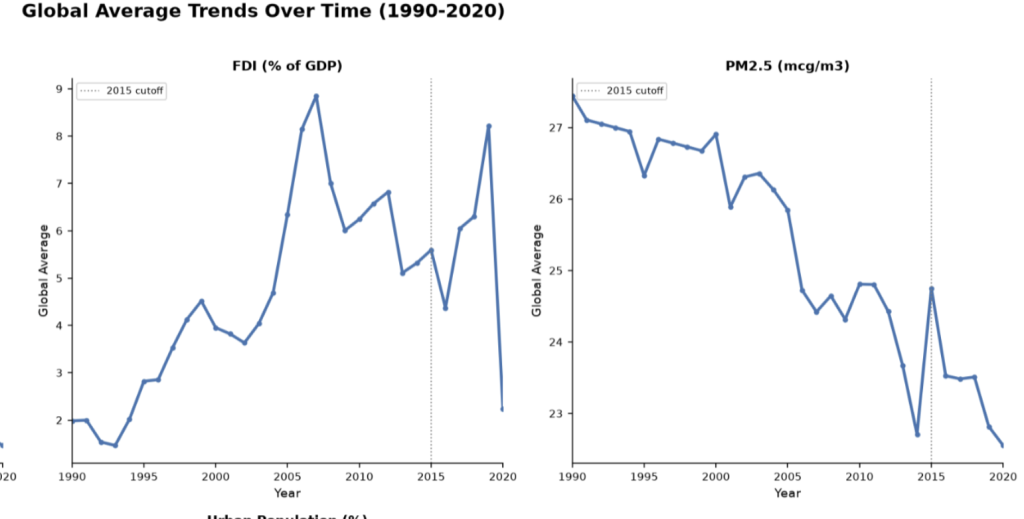
From 1990-2020 FDI fluctuated greatly, but overall increased for much of the period while PM2.5 generally decreased substantially which suggests no simple aggregate relationship between greater foreign investment and greater pollution.
However the histograms show a wide range for countries.FDI is relatively low for most countries with a few very high outliers while PM2.5 levels are more distributed revealing that countries can have various combinations of FDI and pollution.
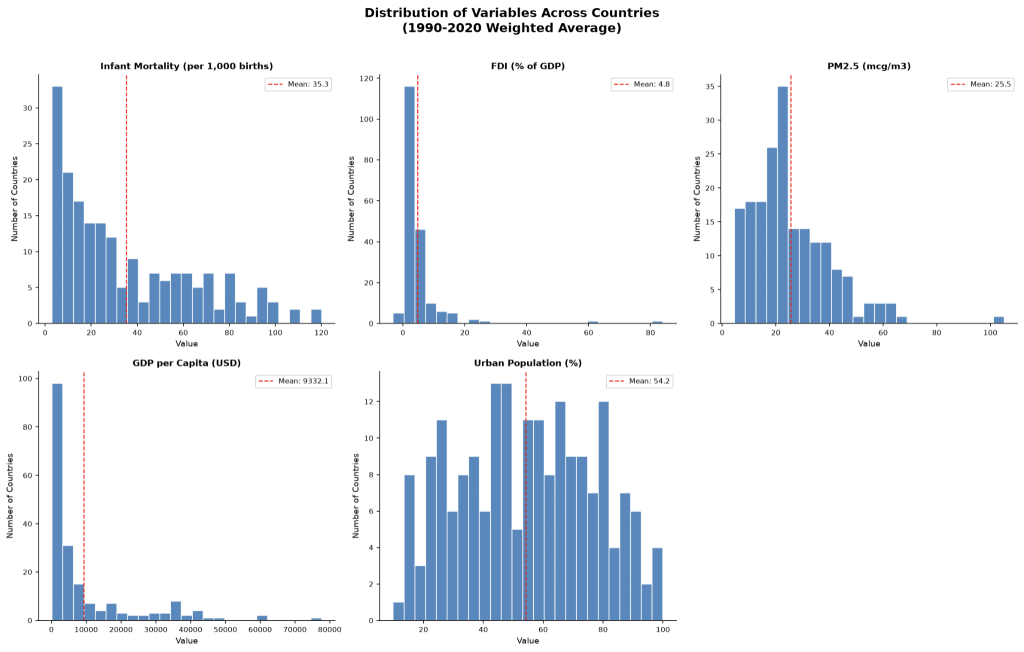
This variation across countries suggests other factors have an impact on the environmental consequences of FDI, instead of FDI automatically contributing to higher pollution. The global model verifies this pattern with an R-squared value of 0.53. The near zero coefficient of 0.002 indicates for every one percentage point increase in FDI, infant mortality is associated with an increase of 0.002 deaths per 1,000 births, effectively zero. Additionally the p-value of 0.99 suggests there is almost no statistical evidence that FDI has a direct impact on infant mortality.
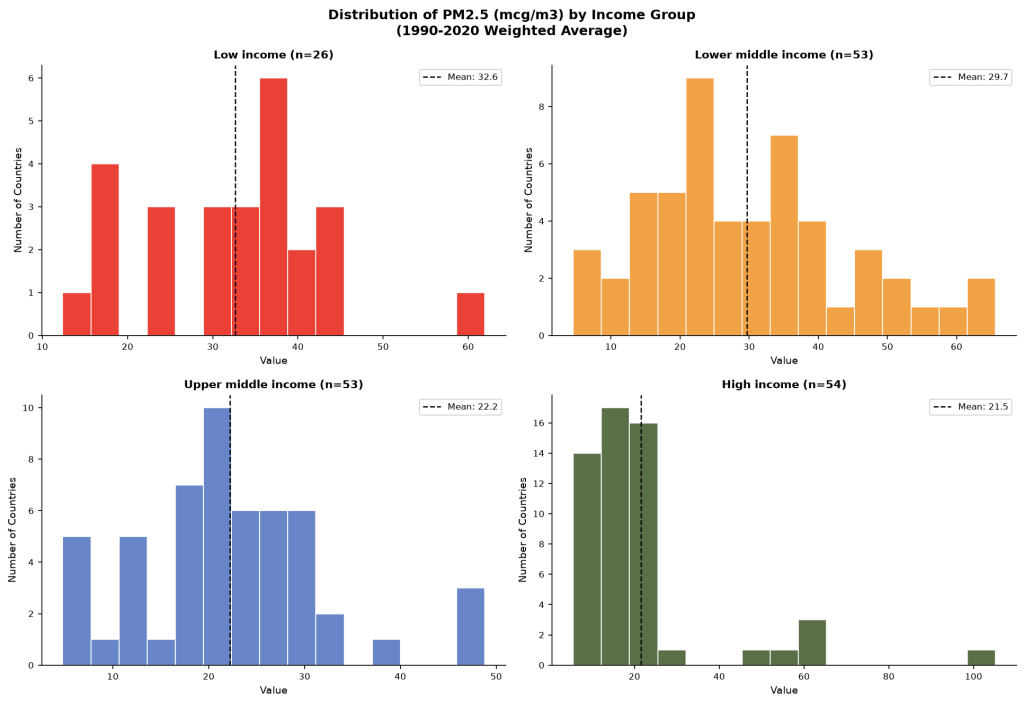
Separate regressions by income group reveal that FDI has a significant positive relationship with infant mortality in upper middle countries and a marginally significant relationship in low income countries, while no significant relationship is seen in lower middle and high income countries. Average FDI increases in high income countries, while average PM2.5 decreases from 32.6 to 21.5 mcg/m3.
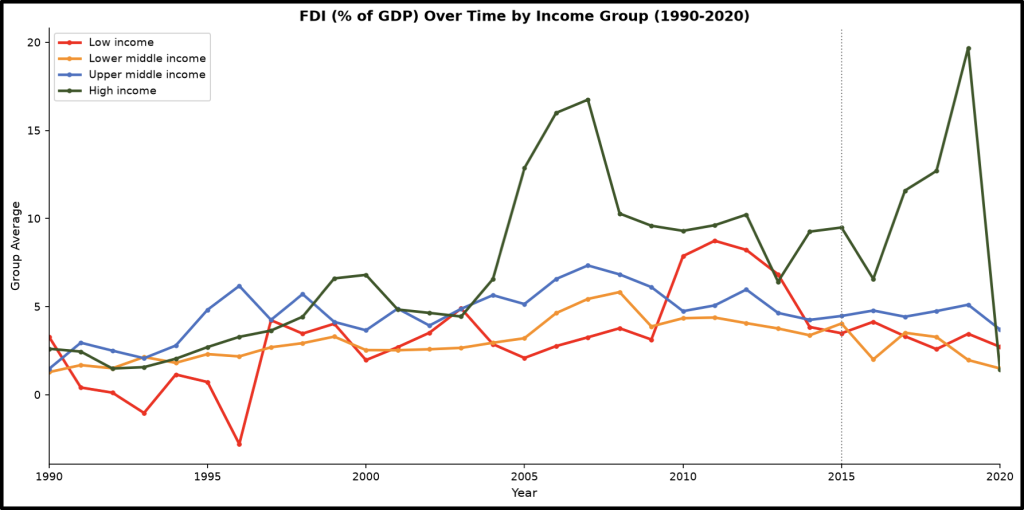
The FDI time series graph additionally displays these differences by showing the volatility where high income groups tend to have many extreme spikes and lower income groups remain relatively stable.
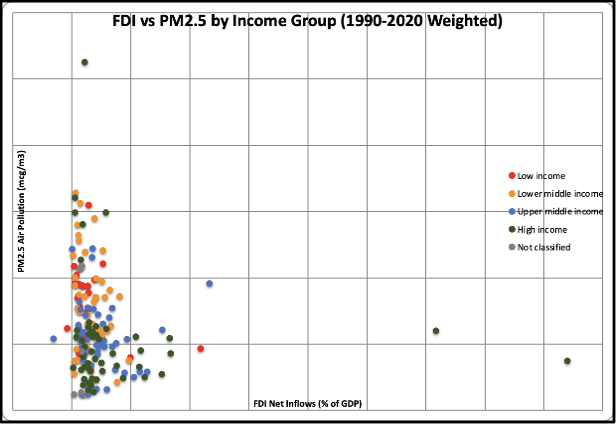
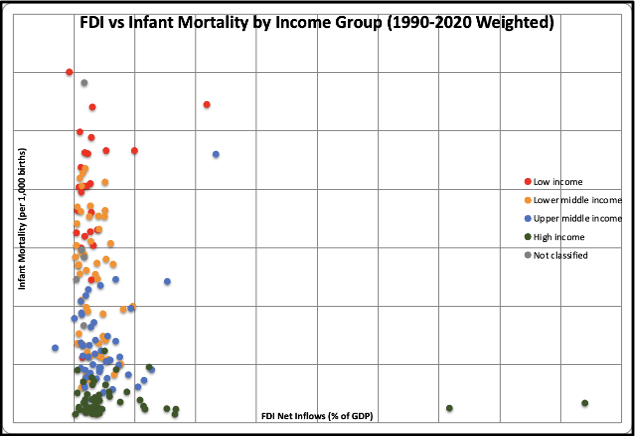
Scatterplots between FDI vs PM2.5 and FDI vs infant mortality continue to show separation with low and lower middle income groups with higher levels of PM2.5 and infant mortality and higher income countries more centered with lower levels, despite a trend of receiving higher FDI.
The regression results lead to a clearer picture. With a coefficient of 1.5052 and a p value of 0.0023,
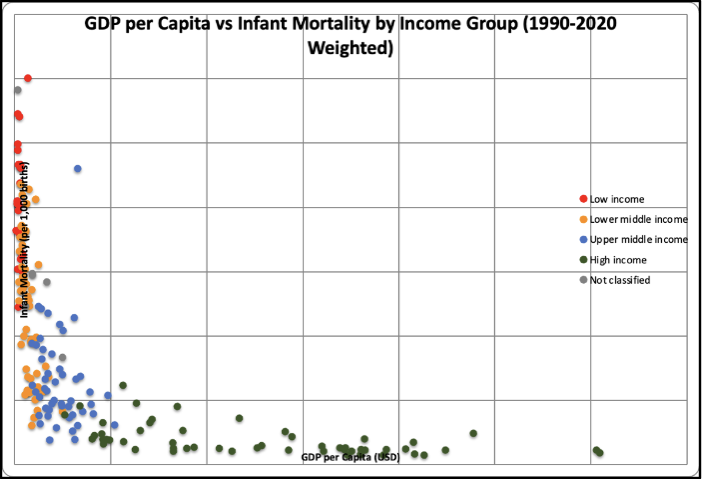
Upper middle income countries have the strongest relationship between infant mortality and FDI, while low income countries follow with a coefficient of 2.2574 and a p value of 0.0621 suggesting that poorer countries may be more susceptible to negative foreign investment effects. However there is no statistically significant relationship in lower middle income countries (coefficient of -1.5753, p = 0.2051) and high income countries (coefficient of -0.0215, p = 0.5926). Lower middle income countries show that general economic development may be more relevant towards infant mortality with a p value of 0.001 with GDP where broad economic development drives infant health improvement. Higher income countries, which are associated with stronger institutions and health systems, can absorb the negative impacts of FDI therefore resulting in a weaker relationship.
Important limitations of this study include that the results prove correlation, not causation, meaning the regression cannot prove that FDI directly causes changes in infant mortality. In addition, other factors may influence both FDI and infant mortality such as government policies, healthcare access, or infrastructure. This data also does not identify the sector receiving FDI. A manufacturing plant can have very different environmental consequences than a call center. The type of foreign investment may aid in explaining differences found across income groups.
There are also limitations within the data itself, including a low sample group of low income countries potentially making that data more sensitive to individual countries more than larger income groups. Lastly PM2.5 is measured with varying quality throughout countries, with some countries having more advanced pollution monitoring systems than others.
4. Conclusion
Ultimately, the relationship between infant mortality and foreign direct investment is more complex than a single global trend. These differences within income groups show that the effects of
foreign direct investment is up to the environmental and economic conditions of the country receiving it. Future research can strengthen this study by using panel data to track changes within individual countries instead of relying on averages from 1990-2020. Additionally FDI could be separated by economic sectors, such as manufacturing, to help determine whether the effects of FDI on infant health change depending on which industry receives the investment.
Lastly, future research can investigate why the relationship differs with income groups. Specifically, researchers can examine whether strong environmental regulations weaken the relationship found in upper middle countries. Or if carbon emissions or water pollution, other measures of pollution, can be studied to see if the same pattern is continued with PM2.5. These questions can help identify the specific conditions that determine whether health outcomes are benefited or harmed by foreign investment.
Works Cited
World Bank. (2026). World Development Indicators [Data set]. World Bank DataBank. https://databank.worldbank.org/source/world-development-indicators
Cole, M. A., Elliott, R. J. R., & Zhang, L. (2017). Foreign direct investment and the environment. Annual Review of Environment and Resources, 42, 465–487. https://doi.org/10.1146/annurev-environ-102016-060916
Health Effects Institute. (2025). State of global air 2025. State of Global Air. https://www.stateofglobalair.org/
Heft-Neal, S., Burney, J., Bendavid, E., & Burke, M. (2018). Robust relationship between air quality and infant mortality in Africa. Nature, 559, 254–258. https://doi.org/10.1038/s41586-018-0263-3
Institute for Health Metrics and Evaluation. (2025). Global Burden of Disease Study 2023.
Singhania, M., & Saini, N. (2021). Demystifying pollution haven hypothesis: Role of FDI. Journal of Business Research, 123, 516–528. https://doi.org/10.1016/j.jbusres.2020.10.007
World Health Organization. (n.d.). Air pollution. https://www.who.int/health-topics/air-pollution
About the author
Avina Christie
Avina is a high school student interested in economics, environmental science, and understanding how global economic activity affects human well being. She enjoys using data to uncover patters across countries and real world issues. Outside of academics Avina loves to volunteer, play soccer, dance ballet, and spend time with family, friends, and her two dogs.