


Author: Anthony Qian
Robert Louis Stevenson High School
Abstract
Invasive brain-computer interfaces (BCIs) have the ability to restore deprived functions in people with severe paralysis such as communication and movement. The longevity of said devices hinge on whether implanted electrodes can integrate into the brain’s system and record neural signals over time. However, the brain often walls off these rigid, high-density architectures, which records the best, causing chronic neuroinflammation, degrading signal recordings over time.
In this review, we categorize different neural interfaces into four distinct stages, each with their benefits and drawbacks: Intruder, Neighbor, Partner, and Symbiotic Organ. The Intruder stage offers the highest quality recordings, trading off disturbing tissues locally in the brain due to the rigidity of electrode arrays. The Neighbor stage utilizes flexible and mesh electronics that are more compatible with the softness of brain tissue. The Partner stage employs new materials: graphene, carbon nanotubes, and liquid metals, which constitutes functions beyond basic electrical recording. In the Symbiotic Organ stage, an interface would integrate itself into the neural tissue and has the ability of self reparation, allowing it to function as a part of the nervous system instead of a separate implant.
This paradigm is not a strict categorization of different device, it offers a way to label different systems to their strengths and limitations. Some devices are often hybridized combinations of different stages, and newer designs are not automatically superior to predecessors. Issues with longevity are not limited to biological reactions such as inflammation or scarring; it can also derive from abiotic failures, such as connector failure, insulation damage, and material degradation. On the other hand, rigid arrays holds some of the strongest long-term human records in signal quality. Overall, optimal systems will come from a combination of co-designing materials as well as adaptive computation together. The goal is not only to record stronger signals, or more electrode channel counts, but also to build interfaces that can remain useful inside the brain for many years.
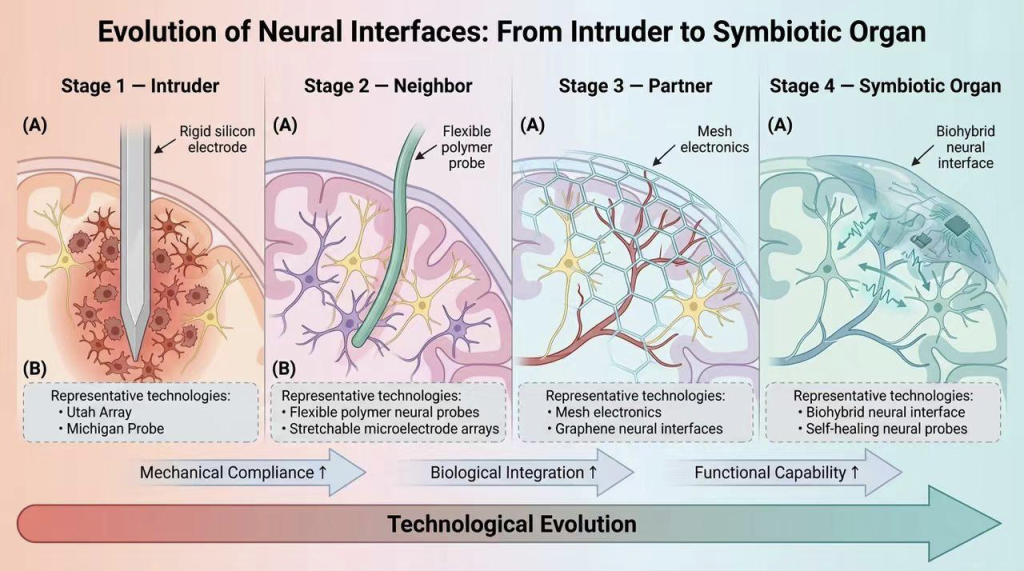
Fig. 1. The four-stage framework for the evolution of invasive neural interfaces: Intruder, Neighbor, Partner, and Symbiotic Organ. Image generated by the author using ChatGPT (OpenAI).
1. Introduction
Over the past decade, invasive BCIs have become physical experiments. They have restored basic functions, such as control and communication for individuals inflicted with severe paralysis, including cursor operations through neural control (Hochberg et al., 2006; Simeral et al., 2011), high-performance clinical neural prostheses (Gilja et al., 2015), reach-and-grasp with a robotic arm (Hochberg et al., 2012), brain-controlled functional electrical stimulation for reanimating the limb (Ajiboye et al., 2017), and high-bandwidth brain-to-text communication (Willett et al., 2021).
How much of this bottleneck is physical rather than computational remains contested. One line of work treats signal degradation as a hard ceiling: once units are lost to chronic tissue response or device failure, no decoder can recover information absent from the recording (Barrese et al., 2013; Chestek et al., 2011; Salatino et al., 2017). A second line demonstrates that a great deal of apparent degradation is nonstationarity rather than information loss and that closed-loop adaptation (Orsborn et al., 2014) and variability-robust decoder architectures (Sussillo et al., 2016) absorb substantially more drift than the first framing implies. We take the acquisition layer as the primary determinant of longevity while noting that its boundary with computation is precisely what remains unsettled, a point we return to in section 3.3. In the end, how well the systems architecture integrates into the brain is the most important factor: signal quality, longevity, and clinical usefulness all suffer if the connection degrades.
This constraint limits the modality of designs of Brain Computer Interfaces. Non-invasive systems such as electroencephalography (EEG) are safer and more accessible, but volume conduction and the skull’s spatial filtering cap their spatial resolution and signal-to-noise ratio, limiting the neural detail recoverable at the scalp (Srinivasan et al., 1998). Invasive interfaces instead capture local field potentials and spiking activity with millisecond precision and cellular-scale specificity, which is what makes high-performance applications possible (Hochberg et al., 2006; Wolpaw et al., 2002). Rigid intracortical arrays such as the Utah Array (Maynard et al., 1997) and high-density silicon probes of the Neuropixels class (Jun et al., 2017; Steinmetz et al., 2021) are the pinnacle of highest-fidelity approach.
Increased signal fidelity will often sacrifice clinical usefulness after an extended period of time. Many high-density systems that rely on rigid, silicon-based construction, whose elastic modulus are several times bigger in magnitude in comparison to brain tissue. The mechanical mismatch amplifies micromotion-induced strain and chronic injury (Minev et al., 2015; Salatino et al., 2017), which in turn drive persistent inflammation, glial scarring (gliosis), neuronal loss near the implant, and progressive signal decline (Minev et al., 2015; Salatino et al., 2017). This is the paradox at the core of BCI hardware: the structures best suited to high-precision electrophysiology are often the ones most prone to causing long-term biological disruption (Minev et al., 2015; Salatino et al., 2017). The field has therefore started a shift opted in more compatible materials and designs which are less physically disruptive to the brain. As a result, these systems counteract mechanical mismatch and immune response without sacrificing the signal quality needed for useful recording.
This framework is not strictly in a chronological timeline. Some devices hybridize between different stages: Neuralink combines high channel count with flexible materials such as threads and robotic insertion, while mesh electronics may behave as Neighbor or Partner systems depending on whether the emphasis is mechanical integration or multifunctional sensing. The categories are therefore not fixed rules, rather flexible, useful labels.
To organize this response, we introduce a four-stage framework for the evolution of invasive neural interfaces: Intruder, Neighbor, Partner, and Symbiotic Organ (see Fig. 1). The sequence describes a progressive and linear shift from rigid foreign implants toward biologically integrated, adaptive bioelectronic systems, and it gives us a consistent way to compare how each generation navigates the paradox between signal fidelity and biological integration.
2. Evolution of Invasive Neural Interface Technologies
Invasive neural interfaces have developed through distinct paradigms, each a different attempt to reconcile high-fidelity recording with long-term biological compatibility.
2.1 Rigid High-Density Electrode Arrays: The “Intruder”
The Intruder paradigm is often categorized by a pursuit of high-fidelity recording, utilizing rigid, silicon-based microelectrode arrays to receive signals. Devices such as the Utah Array and, more recently, Neuropixels probes are the pinnacle of spatial resolution, channel counts, and temporal precision, properties that can easily detect single-neuron activity and dynamics in population(Jun et al., 2017; Maynard et al., 1997; Steinmetz et al., 2021). Other devices such as Neuralink have scaled this approach along, further raising the ceiling of channel counts and automating implantation while maintaining signal quality transfusion. (Musk & Neuralink, 2019). However, it must be said that Chronic instability is not an inherent property of rigid devices. Neuropixels 2.0 was designed explicitly around stable long-term recording, pairing a miniaturized probe with methods for tracking the same units across multiple sessions, for an extended period of time in various conditions (Steinmetz et al., 2021), a rigid device pursuing the stability as their objective is usually credited to compliant ones. The paradigms are connecting shared goals from opposite starting points, which is why they are better labeled as design logic instead of chronology. Mechanical rigidity is a key focus: it gives positional stability during implantation and precise targeting between cortical layers, making these arrays the gold standard for short- to medium-term performance in both experimental and clinical settings. The Utah Array and Neuropixels have high signal fidelity, but they often sacrifice biocompatibility.
Additionally, the same rigidity of the paradigm’s design focus is their defining limitation. Because the elastic modulus of silicon-based probes are magnitudes bigger than the brain cells, the implant sits in permanent state of conflict with the soft, viscoelastic tissue around it. Over time this provokes a chronic foreign-body immune response, persistent inflammation, glial scarring, neuronal loss at the electrode surface, and micromotion-induced strain (Minev et al., 2015; Salatino et al., 2017), which steadily lowers the quality of recordings over a long period of time (Chestek et al., 2011; Simeral et al., 2011).
This causal story is, however, is an incomplete summary of attempts at correcting these flaws. Barrese et al.’s (2013) failure-mode analysis of silicon arrays in vivo attributed a large fraction of failures not to the foreign-body response but to abiotic modes, including connector and percutaneous pedestal failure, insulation cracking and delamination, and progressive material degradation. Their retrospective analysis of seventy-eight silicon arrays implanted in twenty-seven macaques found that most complete recording failures were not attributable to the foreign-body response at all. Acute mechanical failure was the single largest class at 48 percent, and 83 percent of those traced to the percutaneous connector rather than to anything occurring at the electrode-tissue boundary; material failures, including broken tips, insulation leakage, and parylene cracking and delamination, accounted for most of the remainder. Grossly observable biological failures made up 24 percent, the most common single mechanism being progressive meningeal encapsulation (14.5%). Mechanical and material modes together thus account for roughly three-fifths of failures (Barrese et al., 2013). A large share of array loss therefore occurs in packaging, wiring, and connector hardware, components that compliance-based redesign of the electrode does not touch.
One qualification protects this claim from over-reading. Barrese et al. (2013) define failure as the absence of extractable action potentials across all channels of an array, so their categories register catastrophic device death rather than the gradual attrition of usable units. Progressive, gliosis-driven decline in unit yield, the degradation most consequential for BCI performance and precisely what the Neighbor paradigm targets, would largely not count as a failure under this definition. The 24 percent figure therefore bounds the biological contribution to total array loss, not to signal degradation. This is the sharpest available illustration of why sources in this literature so often appear to disagree: Barrese et al. (2013) measure when a device dies, whereas chronic-yield studies (Chestek et al., 2011; Simeral et al., 2011) measure how well it performs while alive, and conclusions drawn from one cannot be transferred to the other without argument.
The Intruder paradigm’s limitation is not simply that it is too stiff: it fails along at least two partly independent axes, and the more frequent one is not biological. The Intruder paradigm does not resolve the paradox; it accepts biological instability as the price of maximal instantaneous fidelity.
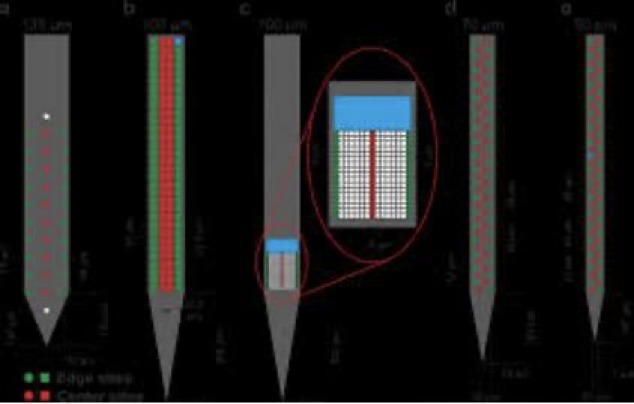
Fig. 2. Five high-density planar silicon probes ordered by shank width (a 32-channel NeuroNexus polytrode, 128- and 255-channel NeuroSeeker probes, and two Neuropixels variants), with edge recording sites shown in green and center sites in red. Reproduced from Fiáth et al. (2021), Figure 1 (CC BY 4.0).
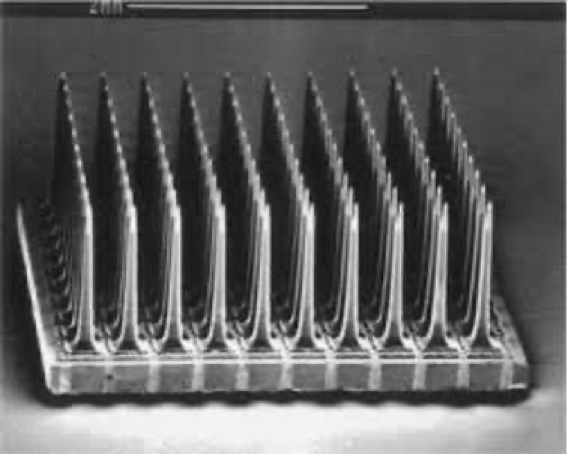
Fig. 3. Scanning electron micrograph of the Utah Intracortical Electrode Array, a 10 × 10 grid of 1.2-mm silicon needles on a 4.2-mm-square base. Reproduced from Maynard et al. (1997), Figure 1.
2.2 Flexible and Mesh Electronics: Transitioning to a “Neighbor”
The Neighbor paradigm softens the interface to better integrate to the needs of neighbouring brain tissues. Work on syringe-injectable electronics and macroporous mesh architectures showed that ultraflexible, polymer-based electrode networks integrate more seamlessly into tissue, attenuating the chronic immune response and enabling stable recording over extended timescales in animal models (Liu et al., 2015; Xie et al., 2015). By lowering bending stiffness to approach the mechanical compliance of brain tissue, these systems reduce the micromotion-induced damage that defines the Intruder problem (Jeong et al., 2015; Zhang et al., 2020).
Bio-integration is just part of the upside. The porous architecture of mesh electronics allows tissue interpenetration and vascularization, so the implant will not clash and compete(Xie et al., 2015). Neighbor designs therefore prioritize long-term integration and stability over recording density, and this comes at a considerable cost. Flexible architecture, however, raises the issue of not hitting the necessary threshold of electrode counts, and because they cannot penetrate tissue unaided, delivery depends on syringe injection (Liu et al., 2015) or temporary stiffening shuttles, approaches that will inevitable complicate the surgical procedure and whose procedures to the human cortex remains untested. Even so, the flexible and mesh electronics architecture serves as proof of principle that long-term neural implants are viable without defects such as tissue disruption. This decouples one side of the paradox entirely. Recent reviews furthers this idea, arguing that longevity and soft, flexible structures go hand in hand, rather than opting for rigid recording elements alone (E. Song et al., 2020).
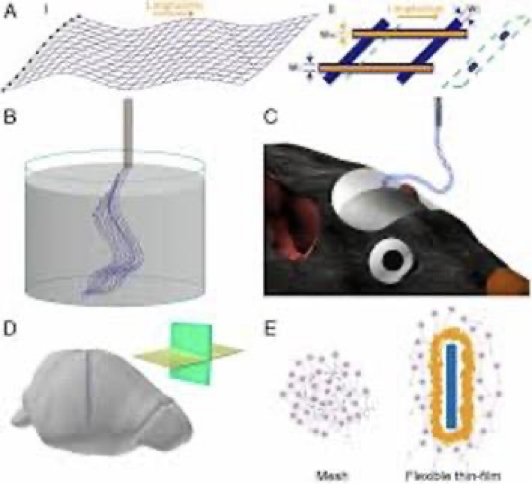
Fig. 4. Syringe-injectable mesh electronics: the mesh design and single unit cell, injection into the mouse brain, and a comparison of the open mesh with a conventional flexible thin-film probe. Reproduced from Zhou et al. (2017), Figure 1.
2.3 Novel Material-Based Electrodes and Hybrid Designs: The Functional “Partner”
The Partner paradigm does not further increase along the biocompatibility pathway, instead it diverges. Where mesh electronics optimize a single figure in its metric, longevity of passive recording systems(Xie et al., 2015), transparent graphene arrays, an example of a partner paradigm, are built to increase a different metric altogether, combining electrophysiology with simultaneous optical access to the same circuit (Kuzum et al., 2014). The two paradigms, Partner and Neighbour, are not contrasting solutions; instead, they sought to answer differently about what an interface is for, and who they are designed for. Resulting in the direct performance comparison between them as largely meaningless, arbitrary numbers. This stage is defined by materials such as graphene, carbon nanotubes, conductive polymers, and liquid metals that make up the interface. Strictly chosen for a combination of purposes: conductivity, optical transparency, stretchability, and chemical sensitivity (Chapman et al., 2018; Hong & Lieber, 2019; E. Song et al., 2020). Partner interfaces excel through its multimodal and biomimetic interactions rather than passive electrical functions represented by previous two paradigms.
Materials illustrate this shift. Compounds such as transparent graphene electrodes permit electrical recording and optical access to the same tissue at once, permitting an alternative pathway to “view” the brain. Whilst, also enabling simultaneous electrophysiology and two-photon calcium imaging of a single circuit, a pairing that opaque metal electrodes from previous paradigms physically obstruct (Kuzum et al., 2014). Additionally, carbon nanotube coatings enlarge effective surface area whilst lowering impedance, improving electrode-tissue coupling and recording quality (Keefer et al., 2008). Liquid metal conductors add extreme deformability while maintaining electrical continuity, so the interface can track tissue motion (Wen et al., 2019). Together, these materials support researchers in a multimodal approach to record the brain’s activity. By measuring electrical activity and neurochemical signals at once, recent reviews stress that interface performance now hinges on micro and nanoscale engineering, not just electrode composition alone (Chapman et al., 2018; Hong & Lieber, 2019).
This expansion in multimodal approach introduces its own functional costs. Fabrication is often intricate and less feasible, long-term material stability under chronic in vivo conditions remains under investigation, and integration with conventional electronics presents abnormal challenges. However, it must be said that Partner systems expand what the interface can measure, but at the cost of fabrication, packaging, long-term reliability, and clinical translation.
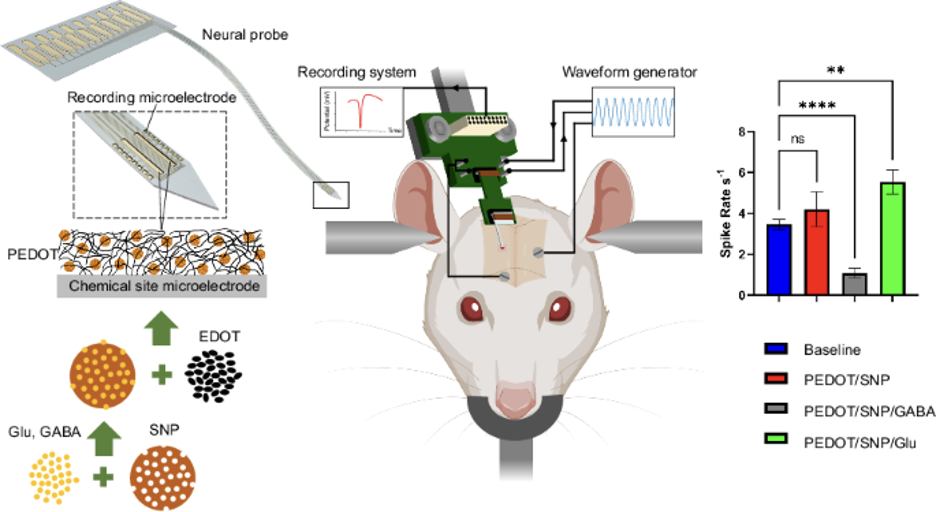
Fig. 5. A fully flexible Parylene C neural probe whose PEDOT/silica-nanoparticle-coated chemical sites electrically release glutamate (Glu) or GABA while neighboring microelectrodes record the resulting increase or decrease in spike rate in rat cortex. Reproduced from Malekoshoaraie et al. (2024) (CC BY 4.0).
2.4 Emerging Injectable and Self-Adaptive Interfaces: Toward a “Symbiotic Organ”
The current frontier reframes the interface as an adaptive extension of the nervous system rather than a static implant. The Symbiotic Organ paradigm proposes a structure of self-healing bioelectronic materials, injectable or self-deploying architectures, and closed-loop systems that respond to changes in neural and tissue state. This vision inherits the Partner stage’s costs and compounds them. The fabrication complexity and uncertain chronic material stability that constrain graphene, nanotube, and liquid-metal interfaces (Keefer et al., 2008; Kuzum et al., 2014; Wen et al., 2019) do not disappear when those materials are asked to additionally self-heal, self-deploy, and operate under closed-loop control; they multiply, and they are joined by power and telemetry demands that passive recording never faced. Self-healing interfaces, for instance, restore electrical and mechanical integrity after mechanical damage, a route to durability that does not depend on avoiding damage in the first place (K.-I. Song et al., 2020).
Dynamic adaptation is what distinguishes this stage. Where earlier paradigms rely on fixed geometries and static material properties, these systems continuously renegotiate the balance between signal quality and biological stability; coupling adaptive decoders with closed-loop control lets the interface respond to neural variability and drift in real time (Orsborn et al., 2014; Sussillo et al., 2016). In principle, an interface that evolves alongside the tissue it inhabits dissolves the paradox rather than trading around it, and bioinspired neuron-like designs push toward that goal by minimizing the structural distinction between device and neural tissue (Yang et al., 2019).
For now, this paradigm is still only a proof of concept, with unresolved obstacles in power delivery, wireless telemetry, computational load, long-term reliability, and safety. They define a long-term direction for the field rather than a deployable technology, and the gap between experimental demonstration and clinical translation remains wide.
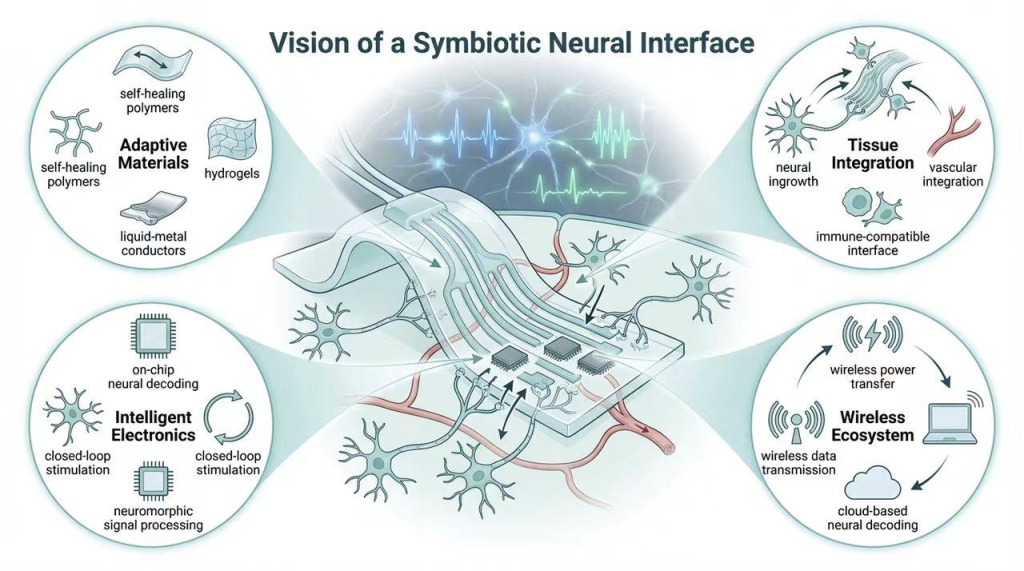
Fig. 6. Conceptual vision of a symbiotic neural interface combining adaptive materials, tissue integration, intelligent on-chip electronics, and a wireless ecosystem. Image generated by the author using ChatGPT (OpenAI).
3. Discussion and Future Directions
The move from rigid intracortical arrays toward adaptive, tissue-integrated systems reflects a shift in the field’s underlying design philosophy. Early BCI work was driven by maximal signal fidelity and spatial resolution, predicated on the assumption that the highest-quality neural data would translate into robust decoding and clinical utility. Decades of chronic-implant experience overturned that assumption: performance depends not on instantaneous signal quality but on the long-term stability of the interface as a coupled biological-technical system. That realization reoriented the field’s priorities from absolute electrophysiological performance toward sustained harmony among tissue, materials, and computation, the transition the Intruder-to-Symbiotic-Organ progression describes.
3.1 Reconciling the Engineering Paradox: A Multi-Dimensional Optimization Problem
The paradox, that high-precision electrophysiology favors rigid, dense structures while long-term biocompatibility demands soft, compliant, adaptive ones has never been solved outright. Each stage handles this trade-off differently.
The Intruder paradigm buys fidelity by absorbing the biological cost: Utah arrays and Neuropixels probes set the benchmark for recording density and temporal resolution, and they accept chronic tissue disruption as the consequence of achieving it. But the accounting is less clean than the paradox implies. If abiotic failure modes contribute as heavily to array loss as Barrese et al. (2013) report, part of what the Intruder paradigm “pays” is not a biocompatibility cost at all, and no amount of movement along the compliance axis will refund it. The Neighbor paradigm moves the balance the opposite way, matching interface mechanics to tissue to lower inflammation and extend recording lifetimes, at the expense of electrode density, targeting precision, and spatial stability over time. The Partner paradigm widens the problem rather than picking a side: by adding optical transparency, neurochemical sensing, or stretchable multimodality, it redefines “performance” beyond electrical metrics, and in doing so exchanges a binary rigidity-versus-compliance choice for a harder question of fabrication and integration. The Symbiotic Organ paradigm attempts to remove the trade-off entirely, letting self-healing materials, self-deploying architectures, and closed-loop control adapt the interface to changing demands, an approach that, for now, exchanges the old paradox for unresolved problems of power, reliability, and safety. Read together, the four stages show the paradox migrating from a fixed constraint into a multi-dimensional optimization problem, not disappearing.
3.2 Insights from Cross-Technology Comparison and Application-Driven Design
No single paradigm dominates across every performance dimension. Rigid arrays lead on fidelity and spatial resolution, flexible and mesh electronics on chronic biocompatibility, material-based hybrids on functional diversity, and symbiotic concepts on adaptability and autonomy. The absence of a universally superior interface indicates that the field is bounded by fundamental trade-offs, not merely by incremental engineering inefficiencies.
Two implications follow. First, progress will come from context-specific optimization rather than a single “best” interface: applications demanding fine motor control or high-bandwidth speech decoding will likely continue to require high-density invasive arrays (Musk & Neuralink, 2019; Pandarinath et al., 2017; Willett et al., 2023), while long-term neuromodulation or monitoring may favor softer, lower-density systems built for chronic stability. Second, this makes application-driven design central: interface architecture should be matched to the physiological, temporal, and functional requirements of the specific use case rather than optimized in the abstract.
3.3 Persistent Field-Wide Challenges and the Need for Co-Design
Several challenges cut across all four paradigms. Long-term biostability is the central one, spanning not only immune response and tissue remodeling but also material degradation, delamination, and electrochemical drift over multi-year timescales. Manufacturing scalability and reproducibility form a parallel obstacle, especially for complex material systems that perform well in the laboratory but resist high yield consistent industrial fabrication. Power delivery and data telemetry impose further limits, particularly for wireless or minimally invasive implants, where energy efficiency and thermal safety become hard constraints.
Computation faces its own version of these problems. Representational drift, non-stationary signal statistics, and user-specific variability complicate decoder design and limit cross-session generalization. Where the ceiling on algorithmic mitigation actually sits is unresolved: results on closed-loop decoder adaptation (Orsborn et al., 2014) and variability-robust architectures (Sussillo et al., 2016) show that computation absorbs more instability than hardware-centric accounts assume, while chronic-yield data (Chestek et al., 2011; Simeral et al., 2011) show it cannot manufacture units that are no longer recorded. The disagreement is not merely academic, because the two positions imply different investments, one in materials, the other in algorithms, and neither literature can settle it alone. This is the strongest argument for co-design: the allocation question is unanswerable unless hardware and computation are developed and evaluated jointly. This interdependence is the argument for co-design, integrating hardware, materials science, and computation from the earliest stages of development rather than optimizing each in isolation. Recent reviews of electronic and flexible neural interfaces reach the same conclusion: future progress depends on tighter integration across materials, device engineering, and system-level signal processing (Hong & Lieber, 2019; E. Song et al., 2020; Zhang et al., 2020).
3.4 Global Perspectives and Collaborative Trajectories
Regional programs bring complementary strengths. In the United States, academic and industrial work often prioritizes high-performance invasive systems and advanced decoding, driven by clinical-translation initiatives and defense funding; Neuralink exemplifies the emphasis on channel count and surgical automation, while others pursue hybrids that balance performance against longevity. In China, research increasingly emphasizes materials science, flexible electronics, and minimally invasive platforms, drawing on strengths in large-scale manufacturing and material synthesis. European groups tend to lead in soft bioelectronics and neuromodulation, prioritizing safety, regulatory compatibility, and long-term implantation. The complementarity suggests that major breakthroughs are more likely to come from cross-border collaboration than from any single region’s dominance.
3.5 Near-Term Breakthroughs: Hybrid Systems at the Interface of Paradigms
A more cautious near-term expectation is that clinically relevant progress will come from partial hybrids rather than fully symbiotic systems. These platforms aim to combine signal quality sufficient for meaningful decoding with improved chronic stability and manageable fabrication complexity. Fully symbiotic systems, though the ultimate goal, still face barriers in power management, reliability, and regulatory approval that make near-term deployment unlikely. The next wave of translational impact is therefore more likely to come from incremental but durable gains in interface longevity, paired with adaptive decoding and closed-loop control.
4. Conclusion
High-performance BCIs could change neuroscience, medicine, and human-machine interaction, but they still face a basic problem: the clearest signals often come from devices that are difficult for brain tissue to tolerate over time. This review traced the field’s response through four stages: rigid Intruder systems, flexible Neighbors, multifunctional Partners, and emerging Symbiotic Organ concepts, each addressing the paradox through a different set of trade-offs. Chronic stability has improved, functional modalities have expanded, and adaptive behaviors have entered the design space, yet no existing technology optimizes every critical dimension at once. Reaching genuinely symbiotic interfaces will require sustained, interdisciplinary work across materials science, system integration, computational neuroscience, and ethical considerations. Four limitations in particular remain unresolved, and each cuts across all stages of the framework. First, an abiotic failure ceiling: because connector, insulation, and material degradation account for a substantial share of chronic array loss (Barrese et al., 2013), improvements in biocompatibility cannot by themselves extend device lifetime. Second, a translation gap: the chronic-stability case for compliant interfaces rests largely on rodent work (Liu et al., 2015; Xie et al., 2015), while the longest human recordings remain those of rigid arrays (Simeral et al., 2011). Third, power delivery and telemetry impose hard energy and thermal constraints on precisely the wireless, minimally invasive systems the Symbiotic Organ concept requires. Fourth, the division of labor between interface and algorithm is still contested (Chestek et al., 2011; Orsborn et al., 2014; Sussillo et al., 2016), leaving open how much instability future systems must engineer away rather than decode around. The clear direction of travel, however, is toward tissue-aware, adaptive design, interfaces that stop behaving as foreign bodies and begin functioning as durable, integrated collaborators within the nervous system.
References
Ajiboye, A. B., et al. (2017). Restoration of reaching and grasping movements through brain-controlled muscle stimulation in a person with tetraplegia: A proof-of-concept demonstration. The Lancet, 389(10081), 1821-1830. https://doi.org/10.1016/S0140-6736(17)30601-3
Barrese, J. C., et al. (2013). Failure mode analysis of silicon-based intracortical microelectrode arrays in non-human primates. Journal of Neural Engineering, 10(6), 066014. https://doi.org/10.1088/1741-2560/10/6/066014
Chapman, C. A. R., et al. (2018). Multifunctional neural interfaces for closed-loop control of neural activity. Advanced Functional Materials, 28(12), 1703523. https://doi.org/10.1002/adfm.201703523
Chestek, C. A., et al. (2011). Long-term stability of neural prosthetic control signals from silicon cortical arrays in rhesus macaque motor cortex. Journal of Neural Engineering, 8(4), 045005. https://doi.org/10.1088/1741-2560/8/4/045005
Fiáth, R., et al. (2021). Recording site placement on planar silicon-based probes affects signal quality in acute neuronal recordings. Scientific Reports, 11, 2028. https://doi.org/10.1038/s41598-021-81127-5
Gilja, V., et al. (2015). Clinical translation of a high-performance neural prosthesis. Nature Medicine, 21(10), 1142-1145. https://doi.org/10.1038/nm.3953
Hochberg, L. R., et al. (2006). Neuronal ensemble control of prosthetic devices by a human with tetraplegia. Nature, 442(7099), 164-171. https://doi.org/10.1038/nature04970
Hochberg, L. R., et al. (2012). Reach and grasp by people with tetraplegia using a neurally controlled robotic arm. Nature, 485(7398), 372-375. https://doi.org/10.1038/nature11076
Hong, G., & Lieber, C. M. (2019). Novel electrode technologies for neural recordings. Nature Reviews Neuroscience, 20(6), 330-345. https://doi.org/10.1038/s41583-019-0140-6
Jeong, J.-W., et al. (2015). Soft materials in neuroengineering for hard problems in neuroscience. Neuron, 86(1), 175-186. https://doi.org/10.1016/j.neuron.2014.12.035
Jun, J. J., et al. (2017). Fully integrated silicon probes for high-density recording of neural activity. Nature, 551(7679), 232-236. https://doi.org/10.1038/nature24636
Keefer, E. W., et al. (2008). Carbon nanotube coating improves neuronal recordings. Nature Nanotechnology, 3(7), 434-439. https://doi.org/10.1038/nnano.2008.174
Kuzum, D., et al. (2014). Transparent and flexible low-noise graphene electrodes for simultaneous electrophysiology and neuroimaging. Nature Communications, 5, 5259. https://doi.org/10.1038/ncomms6259
Liu, J., et al. (2015). Syringe-injectable electronics. Nature Nanotechnology, 10(7), 629-636. https://doi.org/10.1038/nnano.2015.115
Malekoshoaraie, M. H., et al. (2024). Fully flexible implantable neural probes for electrophysiology recording and controlled neurochemical modulation. Microsystems & Nanoengineering, 10, 91. https://doi.org/10.1038/s41378-024-00685-6
Maynard, E. M., et al. (1997). The Utah intracortical electrode array: A recording structure for potential brain-computer interfaces. Electroencephalography and Clinical Neurophysiology, 102(3), 228-239. https://doi.org/10.1016/S0013-4694(96)95176-0
Minev, I. R., et al. (2015). Electronic dura mater for long-term multimodal neural interfaces. Science, 347(6218), 159-163. https://doi.org/10.1126/science.1260318
Musk, E., & Neuralink. (2019). An integrated brain-machine interface platform with thousands of channels. Journal of Medical Internet Research, 21(10), e16194. https://doi.org/10.2196/16194
Orsborn, A. L., et al. (2014). Closed-loop decoder adaptation shapes neural plasticity for skillful neuroprosthetic control. Neuron, 82(6), 1380-1393. https://doi.org/10.1016/j.neuron.2014.04.048
Pandarinath, C., et al. (2017). High performance communication by people with paralysis using an intracortical brain-computer interface. eLife, 6, e18554. https://doi.org/10.7554/eLife.18554
Salatino, J. W., et al. (2017). Glial responses to implanted electrodes in the brain. Nature Biomedical Engineering, 1, 862-877. https://doi.org/10.1038/s41551-017-0154-1
Simeral, J. D., et al. (2011). Neural control of cursor trajectory and click by a human with tetraplegia 1000 days after implant of an intracortical microelectrode array. Journal of Neural Engineering, 8(2), 025027. https://doi.org/10.1088/1741-2560/8/2/025027
Song, E., et al. (2020). Materials for flexible bioelectronic systems as chronic neural interfaces. Nature Materials, 19(6), 590-603. https://doi.org/10.1038/s41563-020-0679-7
Song, K.-I., et al. (2020). Adaptive self-healing electronic epineurium for chronic bidirectional neural interfaces. Nature Communications, 11, 4195. https://doi.org/10.1038/s41467-020-18025-3
Srinivasan, R., et al. (1998). Estimating the spatial Nyquist of the human EEG. Behavior Research Methods, Instruments, & Computers, 30(1), 8-19.
Steinmetz, N. A., et al. (2021). Neuropixels 2.0: A miniaturized high-density probe for stable, long-term brain recordings. Science, 372(6539), eabf4588. https://doi.org/10.1126/science.abf4588
Sussillo, D., et al. (2016). Making brain-machine interfaces robust to future neural variability. Nature Communications, 7, 13749. https://doi.org/10.1038/ncomms13749
Wen, X., et al. (2019). Flexible, multifunctional neural probe with liquid metal enabled, ultra-large tunable stiffness for deep-brain chemical sensing and agent delivery. Biosensors and Bioelectronics, 131, 37-45. https://doi.org/10.1016/j.bios.2019.01.060
Willett, F. R., et al. (2021). High-performance brain-to-text communication via handwriting. Nature, 593(7858), 249-254. https://doi.org/10.1038/s41586-021-03506-2
Willett, F. R., et al. (2023). A high-performance speech neuroprosthesis. Nature, 620(7976), 1031-1036. https://doi.org/10.1038/s41586-023-06377-x
Wolpaw, J. R., et al. (2002). Brain-computer interfaces for communication and control. Clinical Neurophysiology, 113(6), 767-791. https://doi.org/10.1016/S1388-2457(02)00057-3
Xie, C., et al. (2015). Three-dimensional macroporous nanoelectronic networks as minimally invasive brain probes. Nature Materials, 14(12), 1286-1292. https://doi.org/10.1038/nmat4427
Yang, X., et al. (2019). Bioinspired neuron-like electronics. Nature Materials, 18(5), 510-517. https://doi.org/10.1038/s41563-019-0292-9
Zhang, M., et al. (2020). Electronic neural interfaces. Nature Electronics, 3(4), 191-200. https://doi.org/10.1038/s41928-020-0390-3
Zhou, T., et al. (2017). Syringe-injectable mesh electronics integrate seamlessly with minimal chronic immune response in the brain. Proceedings of the National Academy of Sciences, 114(23), 5894-5899. https://doi.org/10.1073/pnas.1705509114
About the author

Anthony Qian
Anthony is a senior at Stevenson School with a strong interest in neuroscience, artificial intelligence, and brain-computer interfaces. His academic interests lie at the intersection of biology, computer science, and machine learning, particularly in understanding brain function and developing technologies that interpret neural activity and human behavior.
Through independent research and hands-on computational projects, Anthony has explored machine learning, behavioral data analysis, and neural signal processing. He is passionate about interdisciplinary research, scientific problem-solving, and applying emerging technologies to advance our understanding of the human brain.