

Author: Yiqi Xu
Mentor: Dr. Tayyeb Shabbir
Trillium School
1. Introduction
Nowadays, artificial intelligence has become increasingly important in many areas, both academically and in real life. Many tasks that were once completed by humans can now be done by AI. In finance, AI is very important because it can analyze large amounts of data in a short period of time and help investors make decisions. See Blackrock (2023).
The stock market is one of the most important parts of the economy because it connects directly to the companies that need money with investors who want to raise their money. This paper will mainly focus on the American stock market. When people buy stocks, they buy small ownership shares in companies. If a company performs well, the stock price will rise, and investors can earn money through capital gains or dividends. On the other hand, the stock market also contains risks, prices can change quickly due to company news, interest rates, investor emotions, and global events. See Investors Business Daily(2024). Because of this, many investors try to find ways to ‘beat the market,’ meaning they want to earn higher returns than the majority of people.
At present, more investors and companies are now using artificial intelligence to analyze data and make investment decisions. AI can deal with large amounts of information much faster than humans, including financial statements, stock prices, and news. This could help investors find patterns, predict price movements, and make better trading decisions. See Blackrock (2023). However, the main concerns are whether AI can provide reliable information to investors and whether AI can provide efficient output in a highly competitive stock market.
AI can improve investment research and decision-making because it allows investors to analyze large amounts of market information more quickly and efficiently. AI can help identify patterns, predict possible price movements, and support better trading decisions. However, since financial markets are competitive, any kind of strategy can quickly become less effective once many investors realize it and start using it. Therefore, this paper will examine how AI can help investors understand the market and improve their decisions, while others realized using AI as a tool to invest. Also considering consistently beating the market, especially for investors without strong data, technology, and risk management. See Blackrock (2023).
This paper will examine whether artificial intelligence can help investors beat the stock market. First, it will explain the basic nature of stocks, how the stock market operates, and the factors that influence stock prices. See Investor’s Business Daily (2024). Second, it will discuss normal and abnormal market returns and explain how benchmarks such as the S&P 500 can be used to determine whether an investor has outperformed the overall market. See Maverick (2015). Third, it will examine the meaning of ‘beating the market’ through Efficient Market Theory and explain why consistently earning abnormal returns is difficult. See Investopedia (n.d.-d). The paper will then discuss several possible ways investors may gain an advantage, including fundamental analysis, investor behavior, technology, and artificial intelligence. It will examine how AI is used in financial markets through algorithmic and high-frequency trading and use DeepSeek as an illustration of AI’s ability to perform financial analysis. See BlackRock (2023), See U.S. Securities and Exchange Commission (2020), See Lu et al. (2025). Finally, the paper will consider the limitations of AI, including its dependence on data, changing market conditions, competition, and unequal access to technology, as well as the policy implications created by the increasing use of AI in financial markets. These sections will provide the basis for evaluating whether AI can create an advantage that allows investors to beat the market and whether that advantage can continue over the long term.
The main question of this paper is whether artificial intelligence can help investors beat the stock market. To answer this question, several related questions will also be considered. What does it actually mean to ‘beat the market,’ and how can investors determine whether their returns are truly above normal market returns? If stock prices already reflect available information under Efficient Market Theory, where could AI find an advantage? The paper will also examine whether AI’s ability to process information faster, identify patterns, and automate trading can create abnormal returns. Finally, it will consider whether these advantages can remain effective over time after accounting for risk, competition, investment costs, and the increasing use of similar AI technology by other investors.
2. Nature of Stock Market
Before understanding whether artificial intelligence can help investors ‘beat the market,’ it is important to understand the fundamental nature of the stock market and what stocks actually are. A stock represents a small ownership share in a company. When investors buy stocks, they become partial owners of that company and are entitled to a portion of its value. Companies offer stocks mainly to raise money for growth, research, and expansion. Investors hope that the company will increase in value over time, which raises the stock price. Investors can also earn money through dividends, which are payments made by companies to shareholders from their profits. See Investor’s Business Daily (2024).
The stock market is the system where stocks are bought and sold. It acts as a market that connects investors who want to buy stocks and those who want to sell them. Prices in the stock market are determined by supply and demand. If more people want to buy a stock than sell it, the price usually goes up. If more people want to sell, the price usually goes down. This change in price is what makes the stock market both profitable and risky. See Investor’s Business Daily (2024).
In the United States, there are two major stock exchanges: the New York Stock Exchange (NYSE) and the NASDAQ. The NYSE is one of the oldest and largest stock exchanges in the world and is known for listing many large, established companies. The NASDAQ is a fully electronic exchange and is more heavily focused on technology companies such as Apple, Microsoft, and Amazon. The NYSE usually has more stable companies, while the NASDAQ has more fast-growing technology companies that often change prices more quickly. Both exchanges function in similar ways, but they have different structures and the types of companies. These exchanges allow stocks to be traded efficiently and in real time, which is essential for modern financial markets. See Investopedia (n.d-b).
Another important concept in understanding the stock market is the idea of stock indices. The stock index is a measurement that tracks the performance of a group of stocks. Instead of looking at one company, an index shows the overall direction of a market or sector. One of the most commonly used indices is the S&P 500, which tracks 500 of the largest companies in the United States. Because it represents a wide range of industries, it is often used as a benchmark to measure the performance of investors and funds. Another major index is the Dow Jones Industrial Average (Dow Jones), which tracks 30 large and well-known U.S. companies and is often used to represent the overall stock market. For example, when people say they are trying to ‘beat the market,’ they usually mean they are trying to outperform the S&P 500. See Maverick (2015), See Investopedia (n.d.-a).
Stock prices are influenced by many different factors. Company performance is one of the most important factors, including revenue, profit, and future growth potential. Economic conditions such as interest rates, inflation, and unemployment also affect stock prices. Fear and excitement can cause prices to rise or fall even when there is no major change in a company’s fundamentals. Global events such as wars, pandemics, or political changes can also impact the entire market. See Investor’s Business Daily (2024).
Because of these factors, the stock market is often difficult to predict. Even though data and analysis can help investors make better decisions, there is always risk. This uncertainty is one of the main reasons why many investors and financial professionals attempt to use advanced tools, including artificial intelligence, to improve decision accuracy and efficiency.
Overall, the stock market is a complex system where companies try to raise the money and investors attempt to earn money. It is influenced by economic data, company performance, global events, and human behavior. Understanding these basic structures before analyzing whether AI can provide an advantage is essential.
3. Normal vs. ‘Abnormal’ Market Returns
It is also important to understand what normal market returns are and how investment performance is measured before determining whether investors can ‘beat the market.’ In this section, the discussion focuses on the American stock market, especially U.S. market indices such as the S&P 500 and the Dow Jones Industrial Average. Since individual investments can have very different performances, investors need a standard to compare their results. By comparing investment returns with historical market performance, investors can determine whether their returns are above the overall market. See The Investopedia Team (2025).
3.1 Normal Market Returns
Normal market returns represent the typical returns investors can expect from investing in the overall stock market over a long period of time. Historically, the stock market has produced average annual returns of approximately 9–10% over periods of 10 years. See Maverick (2015). But this does not mean investors can earn exactly 9–10% every year. Because this average is calculated from many years of market growth and decline. See O’Shea (2026).
Annual market returns can change significantly depending on economic conditions, company performance and global events. During economic growth, companies may gain higher profits, causing stock prices to increase. However, during economic downturns or financial crises, stock prices may decline.
Because yearly returns can be unpredictable, investors usually focus on long-term performance instead of short-term results. A strong investment strategy is not measured by earning a high revenue in one year but consistently produce high revenue over many years. For example, an investor who earns around 10% annually over several decades may be considered successful because they have achieved returns similar to the overall market. See O’Shea (2026).
Understanding normal market returns is important because it provides a scale for evaluating investment performance. If an investor earns returns close to the market average over a long period, they are performing similarly to the overall market. Many investors choose index funds that track major market indices because achieving market-level returns is often more realistic than consistently earning higher returns. See Downey (2025).
3.2 Abnormal Market Returns
Abnormal returns refer to returns that are significantly higher or lower than the expected return. Abnormal returns usually refer to earning returns above a market standard. For example, if the overall market produces an average annual return of 10%, an investor who consistently earns 15% has abnormal returns. See The Investopedia Team (2026).
However, consistently achieving abnormal returns is difficult because financial markets are highly competitive. When new information becomes available, many investors quickly analyze and respond to it. As more investors discover and use similar strategies, the advantage of that strategy often becomes smaller. This makes it challenging for any investor to maintain above-average returns over a long period of time. See Downey (2025).
A temporary high return does not necessarily prove that the investor can consistently beat the market. Short-term success may occur by market conditions, taking higher risks, or totally by accident. To demonstrate the ability to consistently beat the market, the investor must achieve higher returns consistently over many years while considering all the factors such as risk, costs, and changes in market. See The Investopedia Team (2026), See Downey (2025).
This difference between normal and abnormal returns is essentially while analyzing whether artificial intelligence can help investors beat the market. AI may allow investors to deal with enormous amounts of information faster, identify the patterns, and make decisions more efficiently. However, the crucial point is whether AI can create a long-term advantage that produces consistent abnormal returns in nowadays society. See BlackRock(2023), See Downey (2025).
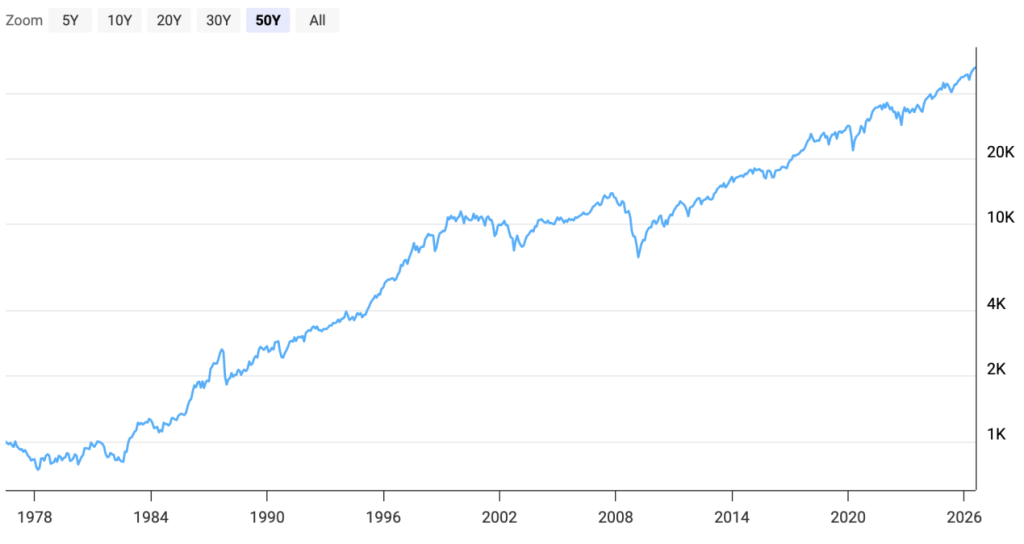
3.3 Figure 1.Dow Jones diagram Over the Past 50 Years
See Macrotrends (n.d.).
This graph shows the long-term performance of the Dow Jones Industrial Average over the past 50 years. Even though the market experienced several periods of decline, such as the dot-com bubble, the 2008 financial crisis, and the COVID-19 market crash, the overall trend has increased over time. This shows that stock market returns can change significantly from year to year, investors who hold stocks in the long term have historically benefited from staying invested. The graph also explains why investors focus on average returns over many years instead of only looking at one year of performance. Some years may have significantly higher or lower returns, but the stock market has produced an average annual return of around 9–10% over a long period of time. See Thune, K (2023).
3.4 Standard Deviation and Investment Risk
Standard deviation can also help explain the risk shown in the graph. Standard deviation measures the distance between yearly returns and average return. If the standard deviation is high, it means the returns are more spread out, so the market has more ups and downs. If the standard deviation is low, it means the yearly returns are closer to the average and more stable. In the Dow Jones graph over past 50 years, the market does not increase smoothly every year. There are many sharp increases and decreases during different periods. This shows that even though the long-term average return may be around 9–10%, the actual return in a single year can be much higher or much lower. Therefore, standard deviation is important because it shows that investors must consider risk, not only average return, when evaluating stock market performance. See Investopedia (n.d.-c).
4. The Meaning of ‘Beating the Market’
Although investors may achieve returns above the market average, consistently producing abnormal returns is extremely difficult. This leads to an important question in finance: if many investors are trying to find advantages, why is it still difficult to consistently beat the market?
4.1 Efficient Market Theory (EMT)
Efficient Market Theory, also known as the Efficient Market Hypothesis (EMH), explains that stock prices reflect available information, including company performance, economic conditions, and public news. When new information appears, investors react quickly, causing prices to adjust. Because many investors compete using the same information, it is extremely difficult to consistently earn returns above the overall market. The implications of Efficient Market Theory are important for investors. If markets are efficient, investors cannot consistently beat the market by only using public information. Therefore, many investors choose passive investing strategies, such as index funds that follow major market indices.(See Investopedia, n.d.-d).
4.2 Three Forms of EMT
EMT has three forms. Weak-form efficiency states that stock prices already reflect past prices and trading patterns. Semi-strong efficiency states that prices reflect all publicly available information, including financial reports and company announcements. Strong-form efficiency argues that prices reflect both public and private information, however this form is controversial because investors cannot legally use private information to gain benefits. This paper will focus on Strong-form efficiency. (See Investopedia, n.d.-d, See U.S. Securities and Exchange Commission, 2023).
4.3 Assumptions for EMT to Hold
Efficient Market Theory helps explain why ‘beating the market’ is such a challenging goal. When information set public and already reflected in stock prices, investors cannot gain an advantage by using the same information available to everyone else. If a strategy creates an advantage, other investors may quickly discover and use the same strategy, reducing its effectiveness. For example, if an investor identifies a stock that appears undervalued, other investors may notice the same opportunity and purchase the stock. Their actions will cause the stock price to rise, reducing the≠ advantage. As more investors compete for the same opportunities, it becomes more difficult to maintain abnormal returns over a long period of time. Therefore, short-term success does not always prove that an investor has a reliable strategy, as high returns may result from favorable market conditions, higher risks, or chance (See Investopedia, n.d.-d).
5. Five Ways Investors May ‘Beat’ the Stock Market: A critical Assessment
Efficient Market Theory explains that consistently beating the market is difficult because available information is quickly reflected in stock prices. However, investors may achieve returns above the market through different strategies. Here are five possible ways include using non-public information, fundamental analysis, investor behavior, advanced technology, and taking greater risks.
5.1. Using Non-Public Information
One possible way to gain an advantage is by having important private information before it becomes public, which is also known as insider trading. Since the information has not yet been reflected in the stock price, an investor may be able to act before the rest of the market. This challenges the strong form of EMT, which states that stock prices reflect both public and private information.
It also violates the EMT assumption that all relevant information is public because some investors have information that others do not. This advantage is not sustainable because it disappears once the information becomes public, and trading based on non-public information is illegal. See U.S. Securities and Exchange Commission (2023).
5.2. Finding Undervalued Stocks Through Fundamental Analysis
Investors can use fundamental analysis to find stocks they believe are undervalued. They can analyze a company’s financial statements, revenue, profits, debt, management, and future growth. If an investor finds a strong company whose stock price is lower than its actual value, the investor may earn abnormal returns when the price increases.
This can violate the EMT assumption that the ability to extract information from a given signal is uniformly distributed because some investors may be better at analyzing the same financial information than others. This advantage may be sustainable for skilled investors, but it can decrease when other investors recognize the same opportunity.
5.3. Taking Advantage of Investor Behavior
Investor behavior can also create opportunities to beat the market. Investors may be influenced by fear, excitement, overconfidence, and herd behavior. For example, negative news may cause investors to be afraid and no willingness to hold the stock, causing its price to fall significantly. An investor who recognizes that the market has overreacted may buy the stock and benefit if the price later recovers.
This violates the EMT assumption that people form their expectations in a rational manner because emotions and biases can affect their decisions. This advantage may continue because investor biases still exist, but predicting this correctly is difficult.
5.4. Taking Greater Risks
Investors may also achieve higher returns by taking greater risks. For example, an investor may invest heavily in a small number of stocks or choose faster-growing companies. If these investments perform well, the investor may earn significantly higher returns than the overall market. Higher returns should be considered with the amount of risk. For example, if the S&P 500 earns 10% and an investor earns 15% by taking significantly greater risks, the additional return will be related to the additional risk. Therefore, risk and return should both be considered when determining whether an investor has successfully beaten the market.
This method does not directly violate an EMT assumption because efficient markets can still provide higher expected returns for investors who accept greater risk. This strategy may produce higher returns over time, but those returns do not necessarily represent an advantage over the market because they come with greater risk.
5.5. Using Hyper Technology, Data, and Artificial Intelligence
In this section, l will examine more deeply how technology and artificial intelligence may give investors an advantage in the stock market. Technology and AI may give investors another advantage. AI can process enormous amounts of information, including financial reports, stock prices, economic data, and news, much faster than humans. It can also identify patterns that may be difficult for individual investors to discover. If AI identifies useful information or patterns before other humans, it may help investors make better decisions quicker and earn abnormal returns. See BlackRock (2023).
This violates the EMT assumption that the ability to extract information from a given signal is uniformly distributed because investors with better AI technology may analyze information faster and more effectively than others. This advantage may become less sustainable as AI becomes more widely used and more investors discover the same patterns and opportunities.
These five methods show separate ways investors are able to gain returns above the market, including using different information, fundamental analysis, investor behavior, advanced technology such as AI, or taking greater risks. Each method involves different opportunities and risks, and its effectiveness can vary depending on market conditions and how it is used.
6. Nature and Impact of High-Frequency and Algorithmic Trading-A deeper look
One technology in investing is algorithmic trading. Algorithmic trading uses computer programs to automatically make trading decisions based on certain rules, market information, or mathematical models. Instead of having an investor watch the market, the computer can continuously monitor stock prices, trading volume, price changes, and other information. Once certain conditions are reached, the system can automatically execute a trade. This allows investment decisions and trades to be completed much faster than humans. See U.S. Securities and Exchange Commission (2020).
6.1 Nature of Algorithmic Trading and High Frequency.
6.1.1 Nature of Algorithmic Trading
These algorithms can be designed for different purposes. For example, an algorithm may compare the current price of a stock with its historical prices, monitor changes in trading volume, or compare prices between related securities. When the system identifies a condition that matches its strategy, it can immediately decide whether to buy or sell. This is especially useful because financial markets constantly produce new information, making it difficult for investors to monitor every change at the same time. Algorithms can also follow the market continuously without being affected by tiredness or emotions such as fear and excitement. See U.S. Securities and Exchange Commission (2020).
Before an algorithm is used in the real market, investors can also test it using historical market data. This process, commonly known as back testing, allows investors to examine how a trading strategy would have performed under previous market conditions. A strategy that performs successfully in historical testing may then be further tested and adjusted before real money is invested. Past performance does not guarantee that the same strategy will continue to work because future market conditions can be different. See U.S. Securities and Exchange Commission (2020).
6.1.2 Nature of High Frequency
High-frequency trading, also known as HFT, is a more advanced type of algorithmic trading that focuses heavily on speed. High-frequency traders use powerful computers and fast connections to analyze market information and complete a large number of trades within a very short period. The profit from an individual trade may be very small, but making a large number of trades make these small profits become larger. Speed is especially important because a trading opportunity may only exist for a very short period before other investors recognize it and stock prices adjust. See U.S. Securities and Exchange Commission (2020).
High-frequency trading operates on extremely short time periods. HFT systems continuously receive information about prices, buy and sell orders, and trading volume from financial markets. The computer analyzes this information and automatically submit, change, or cancel orders when it identifies a trading opportunity. Because these decisions are automated, the entire process can occur much faster than a human investor could analyze the information and manually place a trade. See U.S. Securities and Exchange Commission (2020).
One important factor in HFT is latency, which refers to the delay between receiving market information and responding to it. Even an exceedingly small delay can matter because many HFT firms may be competing for the same opportunity. For this reason, firms invest heavily in powerful computers, high-speed networks, and technology that allows them to receive market data and execute orders as quickly as possible. Some firms also place their computer systems close to the exchanges’ systems, a practice known as co-location, to reduce communication delays. See U.S. Securities and Exchange Commission (2020).
For example, a stock may temporarily have slightly different prices across markets. A high-frequency trading system may recognize this small difference and quickly buy at the lower price and sell at the higher price. The profit from one trade may be extremely small, but the strategy can become meaningful when it is repeated many times. As other trading systems recognize the same price difference, their buying and selling causes the prices to move closer together and the opportunity disappears. This explains why HFT companies invest heavily in computing power and fast connections. Even an exceedingly small difference in the time needed to receive information and execute a trade can affect whether the opportunity still exists. See U.S. Securities and Exchange Commission (2020).
6.2 Artificial Intelligence in Algorithmic Trading
Artificial intelligence can improve algorithmic trading by allowing computer systems to analyze larger and more complicated information. Traditional algorithms usually follow rules created by humans, such as buying or selling when a stock reaches a certain price or certain condition. AI models can analyze relationships between different types of data and identify patterns that may be difficult for humans to recognize. This can help trading systems react more efficiently to changing market conditions.See BlackRock (2023).
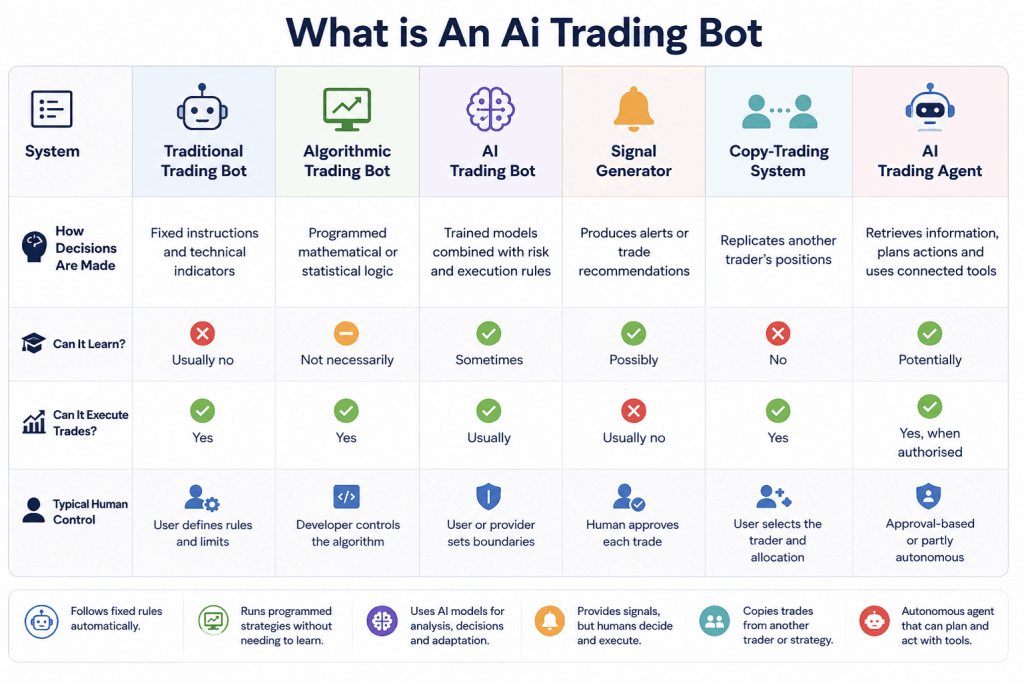
Figure 2. Process of AI-Supported Algorithmic Trading
See Coin Bureau (n.d.).
Figure 2 shows how an AI-supported trading system can move from receiving market information to executing a trade. Market information such as stock prices, trading volume, financial news, and economic data can first be collected and analyzed by an AI model. The system may then identify a pattern or trading opportunity and generate a buy or sell signal. If the conditions of the trading strategy are satisfied, the algorithm can automatically execute the trade. This process can occur continuously and much faster than a human investor could complete the same steps.
Machine learning can make this process more advanced because the system can learn relationships from historical data instead of depending only on fixed rules created by humans. For example, an AI model may consider price movements, trading volume, volatility, and other market information together to estimate the probability that a stock price will increase or decrease. The model can then use this prediction as one factor when deciding whether to trade. This does not mean that AI knows what the stock price will be in the future, but it can use patterns in data to estimate possible outcomes. See BlackRock (2023).
AI can also analyze information that is more difficult to represent with simple trading rules. For example, financial news and company announcements contain large amounts of written information. AI systems can analyze this information and identify whether it may have a positive or negative effect on a company. Combining this information with stock prices and trading data allows an algorithm to consider several types of information at the same time. This creates a major difference between a simple rule-based algorithm and a more advanced AI-supported trading system. See BlackRock (2023).
6.3 Impact of Algorithmic and High-Frequency Trading on the Market
Algorithmic and high-frequency trading can also affect the overall market. Research reviewed by the U.S. Securities and Exchange Commission found that some forms of high-frequency trading can improve market liquidity and price efficiency during normal market conditions. For example, automated trading can increase competition between buyers and sellers and help stock prices respond quickly to latest information. See U.S. Securities and Exchange Commission (2020).
Liquidity is important because it represents how easily investors can buy or sell an investment without causing a large change in its price. When automated traders continuously participate in buying and selling, there may be more opportunities for other investors to complete their trades. Algorithmic trading can also contribute to price discovery because new information can be analyzed and reflected in stock prices very quickly. See U.S. Securities and Exchange Commission (2020).
On the other hand, these systems contain risks. A computer can execute many trades extremely quickly, which means that an error in an algorithm may also affect the market very quickly. During unusual periods of market stress, some algorithmic trading activities may increase costs for investors. An algorithm that works successfully during normal conditions may also react differently when the market experiences an unusual event that was not considered when the system was developed. This shows that speed and automation can improve the trading process, but they also require careful control and risk management. See U.S. Securities and Exchange Commission (2020).
Faster price discovery means that when essential information becomes available, trading activity can help move a stock toward a price that better represents that information. Therefore, algorithmic trading does not only affect investors using the technology; it can also influence how quickly the overall market reacts to new information.See U.S. Securities and Exchange Commission (2020).
The development of algorithmic trading also changes the competition between investors. Investors with faster computers, better algorithms, more data, and stronger AI models may be able to analyze and respond to information before other investors. As more financial institutions develop similar technology, these differences can become smaller and trading opportunities may disappear more quickly. See BlackRock (2023).
This competition can also make the market itself more efficient. When an algorithm discovers a price difference and trades on it, its actions help move the price toward a level that reflects the available information. Therefore, algorithmic trading can create an advantage for investors who recognize opportunities quickly, while at the same time causing those opportunities to disappear more quickly. The success of algorithmic trading is not only based on finding useful patterns, but also on how quickly and accurately investors can act on those patterns before the rest of the market responds. See U.S. Securities and Exchange Commission (2020), See Investopedia (n.d.-d).
6.4 DeepSeek as an Illustration of AI in Financial Analysis
DeepSeek is a Chinese artificial intelligence company founded by Liang Wenfeng. Before establishing DeepSeek, Liang had a strong background in mathematics, artificial intelligence, and quantitative investing. He studied electronic information engineering at Zhejiang University and later earned a master’s degree in information and communication engineering. His early interest in using mathematics and computer technology to analyze financial markets eventually led him into quantitative investing. See Reuters (2025).
Liang later co-founded High-Flyer, a Chinese quantitative hedge fund. Unlike traditional investors who may depend heavily on personal experience and individual judgment, quantitative investment firms use mathematical models, large amounts of financial data, and computer algorithms to identify investment opportunities and make trading decisions. High-Flyer increasingly used artificial intelligence and computing technology as part of this process. This experience gave Liang and his team a strong connection between AI, data analysis, and financial markets. See Reuters (2025).
In 2023, Liang expanded his focus beyond using AI mainly for quantitative investing and established DeepSeek to focus on developing more advanced artificial intelligence models. DeepSeek began researching large language models that could perform tasks such as reasoning, coding, mathematics, and information analysis. The company developed several AI models and released DeepSeek-V3 in December 2024, followed by the reasoning-focused DeepSeek-R1 in January 2025. DeepSeek-R1 received significant international attention because of its reasoning performance and the company’s open approach to releasing its models.See Reuters (2025), See DeepSeek (2024).
The company has a connection to quantitative investing through High-Flyer. Before developing general-purpose AI models, Liang and his team already had experience using algorithms, large datasets, and computing power to analyze financial markets. DeepSeek therefore provides an interesting example of how technology originally developed and applied in a quantitative investment environment can contribute to the development of more advanced AI systems capable of analyzing many different types of information. Liang remains closely connected to High-Flyer today, while also leading DeepSeek, showing that his work in artificial intelligence continues to have a strong connection with his background in quantitative investing. See Reuters (2025).
DeepSeek can be used as an example of how AI can support financial analysis. Investors often need to read financial statements, compare companies, analyze economic information, and perform calculations before making investment decisions. These tasks can require investors to examine enormous amounts of information from different sources. AI can make this process more efficient by organizing and analyzing information much faster than a human investor.
For example, investors can use AI to analyze a company’s revenue, profits, expenses, and debt. AI can also summarize financial documents, compare different companies, and explain complicated financial information. An investor could provide financial information from several companies and ask an AI model to compare their revenue growth, profit margins, debt levels, and other financial measurements. Instead of manually searching through every part of a financial report, the investor could use AI to identify essential information and then examine it more carefully. This allows investors to process larger amounts of information in less time.
DeepSeek can also perform reasoning and numerical tasks that are important in financial analysis. Financial decisions often require more than simply finding information. Investors may need to calculate financial ratios, recognize relationships between different numbers, and determine what changes in financial performance could mean for a company. An AI model that combines information extraction with numerical reasoning can therefore help investors move from collecting information to analyzing it.
Research also shows DeepSeek’s ability to perform financial tasks. BizFinBench tested 25 AI models using 6,781 real-world financial questions involving calculation, reasoning, information extraction, and financial knowledge. DeepSeek-R1 performed especially well in numerical calculation and information extraction. See Lu et al. (2025).
These abilities could be useful when investors need to analyze many companies at the same time. A human investor has limited time to read financial reports from hundreds of companies, while an AI system can process information much more quickly. AI could therefore be used as an initial screening tool to identify companies or financial information that may deserve further analysis. This does not mean that DeepSeek can automatically identify which stocks will increase in price, but it can reduce the amount of time required to complete some parts of investment research.
At the same time, DeepSeek has limitations. The research found that no single AI model performed best in every financial task. Powerful performance in calculation or information extraction also does not necessarily mean that the model can accurately predict future stock prices. A company may have strong financial results while its stock price falls because investors already expected even better results. Stock prices can also be affected by interest rates, economic conditions, investor behavior, and unexpected events that are difficult for an AI model to predict. Therefore, AI can make financial analysis faster and more efficient, but investors still need to evaluate its results carefully instead of completely depending on AI when making investment decisions. See Lu et al. (2025).
7. Limitations
Artificial intelligence can help investors analyze financial information and make investment decisions, but it also has several important limitations. Financial markets are affected by many different factors, and AI cannot perfectly understand or predict every change. Its effectiveness depends on the quality of its data, market conditions, and how investors use its results.
One limitation is AI’s dependence on data. AI models use enormous amounts of historical information, including stock prices, financial statements, economic data, and news, to identify patterns and make predictions. If the data is inaccurate, incomplete, or biased, the results may also be inaccurate. Historical patterns also do not always represent what will happen in the future.
Unexpected events, Wars, pandemics, political changes, natural disasters, and sudden company problems can quickly affect stock prices. These situations may be very different from the historical information used by an AI model. As a result, a model that performs successfully during normal market conditions may perform poorly when the market suddenly changes.
AI models can also make mistakes when analyzing financial information. They may misunderstand information, make calculation errors, or provide conclusions that appear reasonable but are incorrect. The DeepSeek example discussed previously demonstrates this limitation. DeepSeek-R1 performed strongly in several financial tasks but did not perform best in every area. Investors cannot assume that one AI model will always provide accurate financial analysis. See Lu et al. (2025).
Competition can also reduce the advantage provided by AI. If an AI model discovers a useful market pattern, other investors have the same opportunity using similar technology. As more investors find out, AI will reduce the original advantage. This connects with Efficient Market Theory because competition causes new information to become reflected in market prices more quickly.
Another limitation is unequal access to technology. Large financial institutions may have better data, stronger computers, professional programmers, and more advanced AI models than individual investors. Investors may also become too dependent on AI and follow its recommendations without carefully checking the results. AI can support investment decisions, but human judgment and risk management remain important.
Overall, problems with data, unexpected events, AI errors, competition, and unequal access to technology can all affect the performance of AI in financial markets. These are the limitations when AI is used for investment analysis.
8. Policy Implications
As artificial intelligence becomes widely used in financial markets, regulators need to consider its potential risks. AI can improve financial analysis and trading, but incorrect use may affect investors and market stability. Policies should allow technological development but protect investors.
One important issue is transparency. Some AI models are difficult to understand, so financial institutions should remain responsible for decisions made using their systems. Human supervision is also important because AI can make mistakes or respond incorrectly to unusual market conditions.
Regulators also need to prevent misleading claims about AI. Some companies may exaggerate how they use AI or what their technology can achieve. The U.S. Securities and Exchange Commission has described misleading claims about AI as ‘AI washing’ and has taken enforcement actions against investment advisers for making false or misleading statements about their use of AI. See U.S. Securities and Exchange Commission (2024).
Market stability and data security are also important. Algorithmic trading systems can execute many trades very quickly, meaning errors can spread rapidly. AI systems may also use large amounts of sensitive financial information, which needs to be properly protected.
Financial institutions should also be required to test and monitor AI-based trading systems before and during their use. Because automated systems can execute many trades within a very short period, an error can spread quickly through the market. Firms should have risk controls that can limit or stop trading when unusual behavior is detected. See U.S. Securities and Exchange Commission (2020).
Overall, financial policies should balance the development of AI with investor protection, transparency, market stability, and data security.
9. Conclusion
AI can help investors beat the market in some situations because it can process large amounts of information quickly, identify patterns, and react faster than humans. Investors with better data, stronger models, and faster technology may gain an advantage before other investors recognize the same opportunity. See BlackRock (2023), See U.S. Securities and Exchange Commission (2020).
The main issue is whether this advantage can continue over a long period. If more investors use similar AI systems, they may discover the same opportunities, causing stock prices to adjust and reducing the original advantage. This is connected with Efficient Market Theory because competition causes information to become reflected in prices more quickly. See Investopedia (n.d.-d).
AI also has limitations. It depends on historical data, can make mistakes, and may perform poorly when market conditions suddenly change. The DeepSeek example shows that AI can perform well in some financial tasks, but no model performs best in every area. See Lu et al. (2025).
Therefore, AI can beat the market during certain periods, but there is not enough evidence to show that it can consistently beat the market over the long term after considering risk, competition, costs, and changing market conditions. AI is better understood as a powerful tool that can improve investment decisions rather than a guaranteed way to beat the market.
References:
BlackRock. (2023, June 15). How AI is transforming investing. BlackRock. https://www.blackrock.com/us/individual/insights/ai-investing
Coin Bureau. (n.d.). What is an AI trading bot? Coin Bureau.
https://coinbureau.com/education/what-is-an-ai-trading-bot
DeepSeek. (2024). DeepSeek-V3. DeepSeek.
https://www.deepseek.com/en/news/deepseek-v3/
Downey, L. (2025, November 15). Efficient market hypothesis (EMH): Definition and critique. Investopedia.
https://www.investopedia.com/terms/e/efficientmarkethypothesis.asp
Investopedia. (n.d.-a). Dow Jones Industrial Average vs. S&P 500: What’s the difference? Investopedia.
https://www.investopedia.com/ask/answers/difference-between-dow-jones-industrial-average-and-sp-500/
Investopedia. (n.d.-b). Stock market: Definition, how it works, and key concepts. Investopedia.
https://www.investopedia.com/terms/s/stockmarket.asp
Investopedia. (n.d.-c). Understanding standard deviation in investment risk management. Investopedia.
https://www.investopedia.com/ask/answers/021915/how-standard-deviation-used-determine-risk.asp
Investopedia. (n.d-d). What are the differences between weak, strong, and semi-strong versions of the efficient market hypothesis? Investopedia.
https://www.investopedia.com/ask/answers/032615/what-are-differences-between-weak-strong-and-semistrong-versions-efficient-market-hypothesis.asp
Investor’s Business Daily. (2024, May 22). What is the stock market? Moneyworks from Investor’s Business Daily.
https://get.investors.com/moneyworks/how-to-start-investing/what-is-the-stock-market/
Lu, G., Guo, X., Zhang, R., Zhu, W., & Liu, J. (2025). BizFinBench: A business-driven real-world financial benchmark for evaluating LLMs. arXiv.
https://arxiv.org/abs/2505.19457
Macrotrends. (n.d.). Dow Jones – 100 year historical chart. Macrotrends.
https://www.macrotrends.net/1319/dow-jones-100-year-historical-chart
Maverick, J. B. (2015). S&P 500 average return and historical performance. Investopedia.
https://www.investopedia.com/ask/answers/042415/what-average-annual-return-sp-500.asp
O’Shea, A. (2026, March 4). What is the average stock market return? NerdWallet.
https://www.nerdwallet.com/investing/learn/average-stock-market-return
Reuters. (2025, January 29). High-Flyer: The AI quant fund behind China’s DeepSeek. Reuters.
https://www.reuters.com/technology/artificial-intelligence/high-flyer-ai-quant-fund-behind-chinas-deepseek-2025-01-29/
The Investopedia Team. (2025, December 31). What does it mean to ‘beat the market’? Investopedia.
https://www.investopedia.com/ask/answers/03/100903.asp
The Investopedia Team. (2026, May 22). Understanding abnormal returns: Causes and impact on investments. Investopedia.
https://www.investopedia.com/terms/a/abnormalreturn.asp
Thune, K. (2023, January 2). What is the average return of the stock market? Seeking Alpha.
https://seekingalpha.com/article/4502739-average-stock-market-return
U.S. Securities and Exchange Commission. (2020, August 5). Staff report on algorithmic trading in U.S. capital markets. U.S. Securities and Exchange Commission.
https://www.sec.gov/files/Algo_Trading_Report_2020.pdf
U.S. Securities and Exchange Commission. (2023). Insider trading. Investor.gov.
https://www.investor.gov/introduction-investing/investing-basics/glossary/insider-trading
U.S. Securities and Exchange Commission. (2024, March 18). SEC charges two investment advisers with making false and misleading statements about their use of artificial intelligence. U.S. Securities and Exchange Commission.
https://www.sec.gov/newsroom/press-releases/2024-36
About the author
Yiqi Xu
Yiqi is a Grade 12 student in Ontario, Canada, interested in mathematics, finance, artificial intelligence, and computer science. He is especially interested in understanding financial markets and the growing role of technology in investing. He enjoys exploring new ideas in math, coding, and finance.