
Author: Will Nemo
Mentor: Dr. Nikolas R. Webster
Riverdale Country School
Abstract
In 2025, an agreement between the House and the NCAA led to a major change in college sports by finally allowing universities to pay their athletes. This article examines the problem that this change has caused: can universities afford the rising cost of paying their college athletes? According to legal analyses and financial reports, the study points to four pressures caused by the new system. The first of these is that a spending limit linked to revenue increases the financial gap between the wealthy Power Four conferences and the smaller Group of Five, even though the College Football Playoff is expanding in order to improve access. Second, at individual universities, the majority of the funds available are spent on football and men’s basketball, placing a heavy strain on resources. Third, because enforcement is weak, schools are able to get around the spending cap by making arrangements with third parties. Fourth, the universities meet these costs by relying on limited sources such as student fees and tuition increases. The analysis concludes that for sustainable viability it will be necessary to create genuinely new revenue streams, for example through sport-related real estate development, rather than reallocating existing revenues to a permanent and growing expense.
Keywords: name, image, and likeness (NIL); House v. NCAA; the manner in which college athletics are financed; revenue sharing; Title IX; and competitive equilibrium.
Borrowed Time: Can Colleges Reimburse Their Athletes in the Light of House v. NCAA?
For more than a hundred years, college sports have been based on the concept of amateurism. The athletes took part in order to promote school pride and to get a scholarship, not because they were being paid. Even if a quarterback filled a stadium with 100,000 people in attendance, sold thousands of jerseys, and brought in millions of dollars for his university, he would still be ineligible if he earned a single dollar. The NCAA considered this rule to be what made college sports special since it clearly distinguished college sports from professional sports (Henderson, 2023). However, behind this principle a multi-billion-dollar industry developed at the expense of the athletes who were prohibited from benefiting from it.
That contradiction could not continue forever. The first indications of weakness came in 2014, when Ed O’Bannon took the NCAA to court over the use of his image without being paid and won (Henderson, 2023). As pressure increased, the Supreme Court gave a uniform decision in the case of NCAA v. Alston in 2021, proving that the NCAA’s rules could not be maintained under legal scrutiny (Henderson, 2023). A short time later the NCAA gave in and allowed athletes to get money from their name, image, and likeness (NIL). The final element to collapse was the 2024–25 House agreement, which enabled colleges to pay athletes directly, the bigger programs being allowed to spend up to $20.5 million annually (Ropes & Gray, 2025). In under four years college sports had gone from paying athletes nothing to establishing a $2.75 billion NIL market, with $1.95 billion going directly to the athletes (Opendorse, 2025).
That figure represents only the beginning of the earnings that athletes could potentially obtain. While college athletes get only about 13 per cent of the revenue which they help to generate, NFL players receive 48 per cent under their collective bargaining agreement and considerably less than the nearly equal 50/50 divisions found in most professional entertainment (De Lima, 2025). As college sports move towards a fully professional system, the pressure to pay athletes more will only grow, and the funds required to meet that demand are already becoming more difficult to obtain.
The tension will determine the character of the coming period in college sports. At present, universities are burdened by a massive new cost which did not exist a few years ago and all signs suggest that this cost will keep on increasing, even if the income meant to cover it is at most highly uncertain. This leads us to the main question of the paper: can colleges actually afford to meet the growing cost of paying their athletes? In order to find out whether or not schools can keep up with the demands, this analysis looks at four major pressures—specifically, the growing financial gap between the richest conferences and the others, the way in which money is allocated among the different sports at a university, the legal risks involved, the failure to enforce the spending limit, and the limitations of the funding sources on which universities currently rely.
Literature Review
The Widening Gap Between the Power Four and the Group of Five
The financial gap between the richest college football programs and all the others has grown as a result of the House ruling. This gap is not merely about the facilities that the schools have; it is now clearly seen in the amount that each school can pay its athletes. The settlement permits the participating schools to spend up to 22% of their athletics revenue on athlete compensation, and this percentage rises each year—projecting a sum of $33 million per school by 2034–35 (Ropes & Gray, 2025). In this era when there is free market movement of players, the programs have to use up their entire allowance if they are to remain competitive in both recruiting and in keeping players, since if one school decides not to spend, its competitors will very likely do the same instead (Webster & Carr, 2026). In theory all Division I schools are required to abide by the same limit. In practice, however, only the wealthiest programs can afford to meet that limit.
The gap in spending power is huge. Power Four schools can pay their athletes much more because the House limit is based on a percentage of each school’s revenue (Webster & Carr, 2026). The Group of Five conferences are the American, Conference USA, the MAC, the Mountain West, and the Sun Belt. Conferences such as the MAC and Conference USA each earned less than half a billion dollars (Webster & Carr, 2026). These differences stem directly from television contracts: the Big Ten’s media agreement is worth about $8 billion and the SEC’s is approximately $7.1 billion, while smaller conferences receive only a small share of that amount (Webster & Carr, 2026). The amount that a school can spend on athletes is simply a reflection of the television money its conference already has. A school in the Power Four can easily afford the full $20.5 million, while a school in the Group of Five cannot come close.
The House admitted this fact, noting that the Group of Five programs produce considerably less revenue and will therefore spend much less than the amounts allowed by rule (Webster & Carr, 2026). The “cap” does not actually provide a level playing field; it is a ceiling that only the wealthy can attain. For the majority of the Group of Five schools, the more pressing question is not how to reach the cap but whether or not it makes financial sense to join at all. Some have decided that it does not; the entire Ivy League chose not to opt in, and smaller programs such as the University of North Carolina at Asheville decided to remain outside, stating that opting in “would not be advantageous for [its] long-term success” (Ropes & Gray, 2025). In some cases, the cost of trying to keep up may even lead to varsity sports being cut or the school dropping down to a lower division entirely (Ropes & Gray, 2025).
The Irony of Playoff Expansion
The fact that this increasing gap is so obvious is that it runs up against a change which was meant to have the opposite effect. Beginning with the 2024 season, the College Football Playoff (CFP) raised the number of teams from four to twelve in order to make the sport more accessible and to give a greater number of programs a real opportunity to win a national title. In the new system, the highest-ranked team from the Group of Five is guaranteed a place, thus ensuring that a smaller program will reach the sport’s most important event every year (NCAA, 2026). Effectively, the expansion was a commitment to access – a structural move aimed at putting an end to the situation in which a small number of dominant programs had controlled the postseason for a decade.
It is absolutely ironic. As the CFP grew in size, NIL and revenue sharing had greatly widened the gap in talent among the universities concerned. This led to a first-round series of mismatches, since all four of the first-round games were one-sided, each being decided by an average margin of about 19 points and with only one lead change in the four games taken together (Boston Globe, 2024). Boise State, the champion of the Mountain West and the first Group of Five team ever to make it to the playoff, suffered a loss and was defeated 31–14 by Penn State (Yahoo Sports, 2025). Although the playoff had in fact kept its promise of providing access, that access had not brought about any real competitiveness. NIL and revenue sharing go against the very aim of expansion, since they cause the best talent to concentrate at the schools that can afford to pay the most. A team from the Group of Five can now qualify, but it will then have to face teams whose rosters cost many times as much to put together. As demonstrated by Boise State’s heavy defeat at the hands of Penn State, access without the means to compete results in only nominal inclusion.
It must be acknowledged that the different studies do not all reach the same conclusion regarding whether NIL actually results in a concentration of talent at the top. Li and his colleagues (2025), in Management Science, found that talent became more evenly distributed as a result of NIL, with some programs that were ranked lower attracting higher-quality recruits. However, this finding relates to a different matter: while it concerns the recruits who join the programs, it says nothing about a department’s ability to keep its roster from year to year. A well-funded program might lose one recruit and yet still end up spending a great deal more than a smaller school over the entire period of its roster, both through the transfer portal and in terms of retention. Hence, the dispersion observed in one recruiting class does not offset the structural benefit that the House cap gives to the Power Four.
The Divide Within: Revenue Sports, Non-Revenue Sports, and Title IX
The problem is not merely evident in the state of affairs at schools but also shows itself in the increasing division within each department between sports that generate money and those that do not. Even though the settlement did not specify exactly how the schools should allocate their funds, the formula used to calculate the back payments provided a clear precedent: of the about $2.8 billion paid out to former athletes, 95 per cent was awarded to athletes in Power Five football and in both men’s and women’s basketball (75 per cent to football, 15 per cent to men’s basketball and 5 per cent to women’s basketball), while only 5 per cent was given to all the other sports. This has now triggered new discussions regarding budgets and Title IX since the majority of the money is being focused on a small number of programs (Ropes & Gray, 2025). Schools have begun to adopt this approach. For instance, LSU stated that football would receive 75 per cent of its revenue-sharing money and men’s basketball 15 per cent (Cronkite News, 2025). Despite the fact that a university may have twenty or more varsity sports, only two or three of them receive substantial compensation.
This presents a new structural issue. Previously, funds from football and men’s basketball were used to support all the other campus sports. Nowadays, the settlement returns a fixed amount of that money to the athletes who have earned it. Since expenses are increasing, the amount of money available to support the other sports is decreasing. For this reason, schools are having to alter their budgets, increasing student fees, and are considering cutting or reducing their varsity sports (Loeb & Loeb, 2025). Moreover, the settlement has substituted scholarship limits with roster limits, a change which caused a delay in court approval since it would have meant that some athletes would lose their places (Ropes & Gray, 2025). It is now possible for walk-on and backup players to lose their positions so that the department can afford the athletes.
The fact that the distribution is uneven leads to concerns and also involves legal risks since the majority of the money goes to men. Nearly 90 per cent of the settlement payments are made to male football and basketball players (Wingert Grebing Brubaker & Walshok, 2026), which means that male athletes are paid about 90 per cent more than female athletes (Venable, 2025). Eight of the female athletes immediately appealed to the Ninth Circuit just five days after Judge Claudia Wilken had approved the settlement, challenging the back-pay rule under Title IX (Venable, 2025). In order to avoid this problem, the settlement concentrated on the antitrust issue and excluded the Title IX claims (Syracuse Law Review, 2025). The departments are now setting up long-term payment plans based on a distribution that the courts have not yet confirmed. Should a later decision require a more equal split between men and women, the schools would have to either pay the football players less or increase their spending on women’s sports in order to comply. If they decide to increase their spending, their costs will go up again.
Rules Without Teeth: Enforcement and Cap Circumvention
A salary cap only works if it is enforced, and any third-party deals worth $600 or more have to be reported through this portal within five business days and then checked to make sure they have a valid business purpose (Bradley, 2026). Bryan Seeley, who is the chief executive of CSC, said that all the deals had to be legitimate and should not be used as a means of paying for favors (ESPN, 2025).
The problem is that income from third-party NIL agreements remains completely outside the cap, a flaw which critics have called a major disadvantage. While there are restrictions on how much a school can pay an athlete directly, there are no limits on the amount the athlete earns from outside sources, which means that the main way the rule is worked around is by means of agreements with third parties. Schools have used multimedia rights partners, sponsors, and apparel brands to avoid the cap by channeling revenue from their athletic departments into artificial NIL arrangements (Yahoo Sports, 2026). It comes as no surprise since SEC commissioner Greg Sankey stated that changes were necessary because the present system allows the cap to be circumvented through third-party NIL arrangements (Yahoo Sports, 2026). The amount involved is considerable—the CSC has approved almost $300 million in third-party deals since the system was introduced (Yahoo Sports, 2026), and one general manager from the Power Four said that some programs spend more than $40 million in order to field competitive teams (NIL-NCAA, 2026).
Enforcement is in question even when it is attempted. Even though the CSC obtained its first final arbitration in 2026, stopping a number of football transactions in Nebraska which had been deemed improper ‘warehousing’, the lawyers for the House plaintiffs argued that the CSC had exceeded its authority (Buchanan Ingersoll & Rooney, 2026). The CSC is a private body that has been contracted by Deloitte and is not subject to the Freedom of Information Act (Webster & Carr, 2026). It has now been asked to keep a close eye on billions of dollars. The system relies on an entity with unclear legal powers and proceedings that are closed. If the cap does not in fact restrict spending, the amount that schools are budgeted against will not be the real sum they will have to pay.
Where Does the Money Actually Come From?
The one genuine problem that schools have to deal with is how they are to pay for it; in other words, the majority of them cannot afford to meet these expenses by drawing their money from their current athletics, as the table showing the amount earned by the Power Four conferences in comparison to the others demonstrates (see Table 1). According to the NCAA data, only a small number of departments are able to meet their own costs, and the rest have to depend on student fees, institutional support, or go into debt (Minding the Campus, 2026). Because the costs involved reach eight figures even in departments which are already running at a loss, universities have to look for other sources of funding.
Table 1
Total Athletic Revenue by Conference, 2023–24 (Knight-Newhouse College Athletics Database)
| Power Four Conference | Total Revenue | Group of Five Conference | Total Revenue |
| SEC | $2.59B | Mountain West | $0.69B |
| Big Ten | $2.36B | Sun Belt | $0.52B |
| Big 12 | $1.56B | American (AAC) | $0.51B |
| ACC | $1.26B | Mid-American (MAC) | $0.44B |
| Conference USA | $0.30B |
The most evident measure has been the imposition of higher fees: Clemson charges $150 per semester, South Carolina charges $300 per year, Minnesota has a fee of $200 per year and West Virginia charges $125 (SportsEpreneur, 2026). Florida has given approval for auxiliary funding amounting to $22.5 million for its sports program (Front Office Sports, 2025), and Virginia Tech has raised its tuition in order to cover the costs of the athletes (Ropes & Gray, 2025). In some instances, the organisations have had to rely on fundraising and on reorganising: Syracuse has launched a $50 million campaign in order to attract and keep athletes (University Business, 2025), and Kentucky has restructured its athletic department into a non-profit LLC (Ropes & Gray, 2025). Even the conferences which have the greatest resources are now considering private equity as a means of stabilising their cash flow (Webster & Carr, 2026).
There is here a marked irony which once again leads us back to the original issue. The universities that are expected to be the ones getting the greatest amount of financial support—for example, Ohio State, Texas, and Alabama—charge their students very little or nothing at all since television revenue covers the costs. Universities that do not have television revenue, on the other hand, have to pass the cost on to their students (SportsEpreneur, 2026). The worst impact is felt by the schools that are least able to absorb it. A student going to a Group of Five school may now have to pay a compulsory fee in order to finance a payment system that will never make her school competitive with the programs it was meant to help it catch up with. Tuition, fees, and donations are all limited resources. If the cap reaches $33 million by the mid-2030s without a corresponding increase in revenue, the current funding system will become mathematically unworkable for a large number of Division I schools.
A Countervailing Benefit
It is inaccurate to describe the years after the House era as having been merely a difficult time, since one important advantage has developed: Name, Image, and Likeness (NIL) payments are now causing top athletes to remain in college for longer. At the 2026 NBA Draft, all of the twenty players selected in the first round had played college basketball, a first occurrence since 1994 (NBA, 2026). A year before that, in the second round of the 2025 draft, a record number of senior players were picked, a situation which can be directly attributed to NIL, because the players received payment to stay on rather than face the risk of ending up with an uncertain draft position (Sports Illustrated, 2025). For many decades, this incentive has encouraged able athletes to leave college early; NIL has reversed that trend so that more of their academic work is completed and those who do not make it to the professional level have a more practical alternative. About 60% of former NBA players are in financial difficulty five years after they retire (Henderson, 2023), and athletes who stay on for longer experience a rapid influx of wealth while still at university, where they can learn how to manage it—Henderson (2023) points out that states such as Georgia and Louisiana already have requirements of this type. Yet this benefit should not be overestimated, since it is just as unequally distributed as all the other aspects of the issue—only those who can afford to stay are the ones receiving large amounts of money, and this money is concentrated in the well-off programs mentioned above.
The cost, which became compulsory as a result of the agreement in the House, is always increasing, yet it has never provided a reasonable means of financing it nor any method of bringing the costs under control. The two problems exacerbate one another: the costs keep on rising, and the situation still remains unbalanced. The easiest way to address this issue is to fix the meaningless spending cap. As long as third-party NIL deals aren’t counted in the salary cap, the $20.5 million cap means nothing, and schools will end up spending with no way to keep track. The cap will only begin to matter if third-party agreements are included and the College Sports Commission gets access to information on all third-party agreements. A salary cap that can’t be enforced is actually worse than having no cap, because it creates a false sense of control and rewards the colleges which find ways around the rules. The second step is designed to close the growing skill gap between powerhouse and underdog schools in their sports teams. A salary cap will not single-handedly help the Group of Five, since these schools cannot even reach the current limit. A more realistic approach would be a tiered system, where the salary cap matches each conference’s revenue, which would be paired with a revenue-sharing fund sponsored by the most profitable media deals. The Power Four conferences, which make billions from TV, can afford to share some of their income to help the schools that make their schedules possible. You might think this is charity, and these Power Four schools would never agree to it. But it is not just charity. In fact, it is in their own interest, because if games become too lopsided, fans will lose interest and TV money will disintegrate. The strongest and most sustainable solution, in my opinion, is for schools to create new sources of income instead of just trying to nurture their current sources.The ways in which money is currently earned rely on student fees, higher tuition charges, and fundraising. These methods are very limited, and in fact student fees might even interfere with the school’s academic objectives. As Webster and Carr (2026) note, the most viable solution is to make use of real estate connected with sports, for example by setting up mixed-use developments that have shops, housing and entertainment situated near stadiums. This type of development generates income throughout the year and, crucially, is not included in the revenue-sharing pool. Professional sports teams have long used this method since it helps to meet the increasing costs of players. Nowadays wealthier athletic departments can adopt this strategy, but Group of Five schools will have to rely on the kind of shared investment that I referred to earlier. However, the basic principle remains unchanged in all situations: if a new cost has to be covered, a new source of income must be found.
Conclusion
In just four years college sports has gone beyond the boundary that it had been nearly at for a hundred years, and this shift is now permanent. The House settlement did more than simply allow schools to pay athletes; it placed limitations on a financial system which was not designed to cope with such expenses, lacked the ability to regulate spending, and provided no safeguards for schools and sports that are falling behind due to a constantly rising and mandatory cost. As a result, the gap between the Power Four and the other schools has grown wider, pressure has been placed on non-revenue sports, the Title IX problem has still not been resolved – a circumstance which could lead to further cost increases – and a funding model has been put in place that will not be sustainable for most of Division I if it persists into the mid-2030s. The problem cannot be solved by redistributing the money that is already available, since that money is all that is available. Whether or not college sports continues to be a national tradition or becomes something that only a small number of wealthy schools can afford will depend on how quickly schools are able to find new ways of meeting the increasing costs of athletes.
References
Boston Globe. (2024, December 22). Blowouts dominated the first round of the College Football Playoff. Will the quarterfinals be any better? https://www.bostonglobe.com/2024/12/22/sports/college-football-playoff-first-round/
Bradley. (2026, January 21). Enforcing after House: The College Sports Commission and the future of NIL regulation. https://www.bradley.com/insights/publications/2026/01/enforcing-after-house-the-college-sports-commission-and-the-future-of-nil-regulation
Buchanan Ingersoll & Rooney. (2026, May 28). The College Sports Commission prevails in NIL arbitration. https://www.bipc.com/college-sports-commission-prevails-in-nil-arbitration
Cronkite News. (2025, July 10). What the NCAA settlement means for ASU, athlete pay and Title IX. https://cronkitenews.azpbs.org/2025/07/10/asu-house-settlement-athletes-title-ix-2025/
De Lima, M. (2025, August 28). College football’s NIL revolution surges toward $2 billion. Sports Illustrated. https://www.si.com/fannation/college/cfb-hq/nil/college-football-nil-revolution-surges-toward-2-billion
ESPN. (2025, July 31). College Sports Commission loosens prohibition on NIL payments. https://www.espn.com/college-sports/story/_/id/45867746/college-sports-commission-loosens-prohibition-nil-collectives-payments
Front Office Sports. (2025, June 23). Colleges are raising student fees to pay for athlete revenue-sharing. https://frontofficesports.com/colleges-are-raising-student-fees-to-pay-for-athlete-revenue-sharing/
Henderson, T. (2023). It’s about time: An analysis of name, image, and likeness legislation in the United States. Jeffrey S. Moorad Sports Law Journal, 30(1), 61–90. https://digitalcommons.law.villanova.edu/mslj/vol30/iss1/3
Knight-Newhouse College Athletics Database. (2025). College athletics financial database (FBS). https://knightnewhousedata.org/fbs
Li, I., Lu, F., & Qiao, M. (2025). Does personalized pricing increase competition? Evidence from NIL in college football. Management Science. https://pubsonline.informs.org/doi/10.1287/mnsc.2024.06423
Loeb & Loeb. (2025, July 1). College sports enters a new era: House settlement greenlit, student-athletes to be paid. https://www.loeb.com/en/insights/publications/2025/07/college-sports-enters-a-new-era-house-settlement-greenlit-studentathletes-to-be-paid
Minding the Campus. (2026, January 26). College athletics is breaking universities. https://mindingthecampus.org/2026/01/26/college-athletics-is-breaking-universities/
NBA. (2026). 5 takeaways: College players rule 1st round of 2026 NBA Draft. https://www.nba.com/news/five-takeaways-2026-draft-1st-round
NCAA. (2026, February 3). How the 12-team College Football Playoff will work: Teams, schedule, bids. https://www.ncaa.com/news/football/article/2026-02-03/how-12-team-college-football-playoff-will-work-teams-schedule-bids
NIL-NCAA. (2026). NCAA revenue sharing and NIL estimates. https://nil-ncaa.com/
Opendorse. (2025). NIL at four: Monetizing the new reality. https://biz.opendorse.com/wp-content/uploads/2025/07/NIL-at-Four-Monetizing-the-New-Reality_July2025.pdf
Ropes & Gray. (2025, June 20). House v. NCAA settlement approved: Era of direct payments to college athletes begins. https://www.ropesgray.com/en/insights/alerts/2025/06/house-v-ncaa-settlement-approved-era-of-direct-payments-to-college-athletes-begins
Sports Illustrated. (2025). Second round of 2025 NBA Draft sees record number of seniors selected. https://www.si.com/nba/draft/newsfeed/second-round-of-2025-nba-draft-sees-record-number-of-seniors-selected-01jys8zec3pe
SportsEpreneur. (2026, June 11). Student athletic fees: Who really pays for college sports? https://sportsepreneur.com/student-athletic-fees-college-sports/
Syracuse Law Review. (2025, June 19). Title IX and the House settlement: Playing for keeps. https://lawreview.syr.edu/title-ix-and-the-house-settlement-playing-for-keeps/
University Business. (2025, July 21). How student-athlete revenue-sharing is changing college finances. https://universitybusiness.com/how-new-athlete-revenue-sharing-is-causing-staggering-financial-change/
Venable. (2025, July 14). Title IX goes head to head with antitrust: NCAA NIL settlement challenged by female student-athletes in House v. NCAA. https://www.venable.com/insights/publications/2025/07/title-ix-goes-head-to-head-with-antitrust-ncaa
Webster, N. R., & Carr, J. (2026). From NIL to real estate: Strategic revenue adaptation in the post-House era of college athletics. Frontiers in Sports and Active Living, 7, Article 1728507. https://doi.org/10.3389/fspor.2025.1728507
Wingert Grebing Brubaker & Walshok. (2026, February 28). The House v. NCAA effect: How the $2.8 billion settlement is rewriting the rules for California college sports. https://wingertlaw.com/2026/02/28/house-v-ncaa-settlement-california-guide/
Yahoo Sports. (2025). What is the Group of 5 in college football? Explaining the conferences with CFP automatic bid. https://sports.yahoo.com/article/group-5-college-football-explaining-080002236.html
Yahoo Sports. (2026, June 17). With Protect College Sports Act under scrutiny, NIL deals with “associated entities” creating confusion. https://sports.yahoo.com/college-football/article/with-protect-college-sports-act-under-scrutiny-nil-deals-with-associated-entities-creating-confusion-204731149.html
About the author
Will Nemo
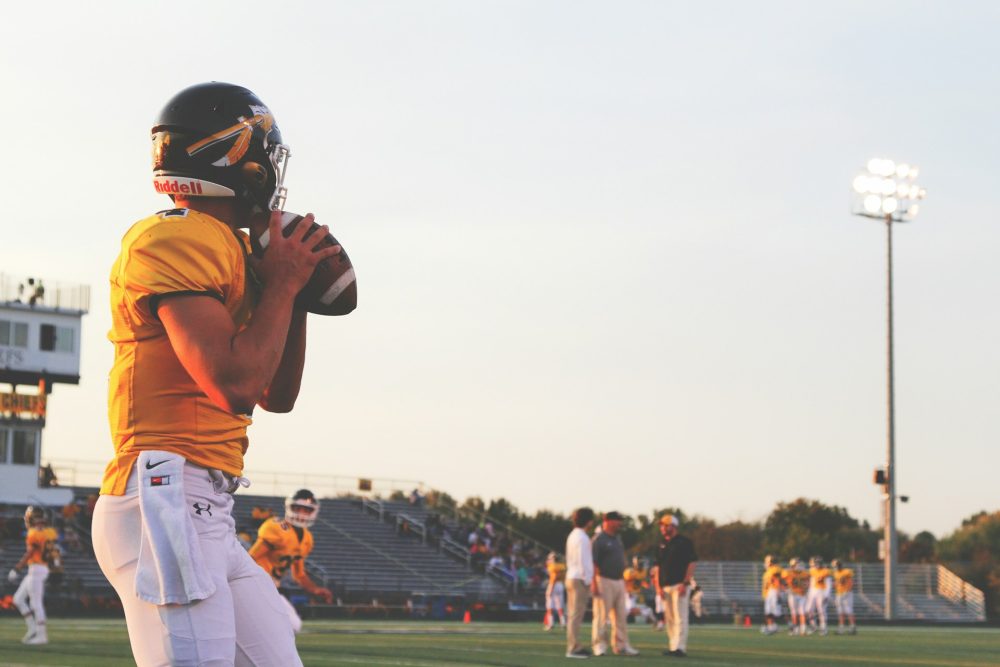
Will is a senior at Riverdale Country School in New York City. His academic interests lie in finance, economics, and the business of college athletics. Outside academics, Will plays quarterback for his school’s varsity football team and follows the college sports industry closely.