

Author: Sloane McDowell
Mentor: Dr. Hong Pan
Miramonte High School
Abstract
Have you ever studied for hours and still failed a test, while someone else barely studied and aced it? This paper explores why this occurs. It turns out grades depend a lot less on how “smart” someone is, and a lot more on habits, mindset, and even the environment around them. This paper looks at personality traits, motivation, and study strategies like quizzing oneself and spacing out studying over many days, along with the brain science behind memory and forgetting. It also examines how classrooms and family income can affect learning, and how AI is starting to change education — for better and worse.
Key Terms
| Intellective versus non-intellective measures | Intellective factors are things that measure how smart or skilled someone already is (GPA and SAT/ACT scores). Non-intellective factors are everything else that helps someone learn or how well they do in school (personality, motivation, and how they study). Conscientiousness is being organized and good at getting things done. Need for cognition means actually enjoying hard thinking, not just being good at it. Locus of control is believing your own effort shapes your learning and grades, instead of believing it’s just luck or fate. |
| Self-efficacy (performance and academic) | Self-efficacy is how confident you are that you can actually do something. Performance self-efficacy is your confidence in a specific goal, such as getting an A on a test. Academic self-efficacy is the belief that you’re a good student overall. |
| Self-regulated learning (SRL) | Self-regulated learning means taking charge of your own learning rather than just letting information pass through you. Active recall is testing yourself instead of just rereading. Elaboration means connecting new ideas to stuff you already know. Metacognition means checking if you really know something or just feel like you do. Automaticity means getting so good at something you can do it without even thinking about it. |
| Growth mindset versus fixed mindset | A fixed mindset is the belief that your abilities are fixed, so you avoid challenges. A growth mindset is the belief that you can get better at anything with effort and practice, so you’re more willing to struggle and try. |
Introduction
It’s 9 a.m. on a Monday, and I am sitting in my first period Calculus class. We just got our tests back, and all I can hear is students whispering to each other, “I studied for hours, and still bombed it” or “How did you do so well? You must be naturally smart.” I couldn’t stop thinking about it: Why did some students who barely studied do fine, while others who studied all night struggled? That question is what motivated me to research how studying actually works and what really helps students succeed.
Most of us grow up assuming grades are just a reflection of intelligence, and that studying more automatically means doing better. Turns out, that’s not actually true. Here’s what’s really happening in a student’s brain: Every time they learn something new, neurons form tiny connections with each other across gaps called synapses. Every time those neurons fire together, the connection gets a little bit stronger. So, when the student goes back over information, especially trying to force themself to remember it, instead of passively rereading it, the connection sharpens. On the other hand, if they never revisit it, the connection weakens, and the memory fades away. This is the problem with rereading something for hours: it can feel productive, but it doesn’t actually build a solid and lasting memory. Real learning happens when your brain has to work to pull information out instead of just looking at it again.
Once I understood this, it changed how I saw the whole “naturally smart” thing. Grades have a lot less to do with raw intelligence than people assume, and more to do with study habits, mindsets, and the environment around them. These are all personal habits on which every student can improve.
The focus of this paper will be on academic success in an institutional environment. First, the paper will examine personality traits and mindset — traits like staying organized and having confidence — which can drastically improve grades. Next, the paper will cover study strategies backed by science, like quizzing yourself instead of rereading and studying a bit over time instead of cramming. Then, the paper will look at the classroom itself, and even things like family income, which can affect how the brain works and learns. Finally, it will examine the future of learning and how AI is changing education for the good and bad. All of this builds towards one main idea: Doing well in school isn’t something a student has to be born with; it’s something they can learn how to do.
Box 1
Bloom’s Taxonomy
The basics of how students obtain mastery of a concept are widely known as Bloom’s Taxonomy. This diagram gives a general summary of what a student must be able to do before they can move up the pyramid to being a professional or expert in a subject.
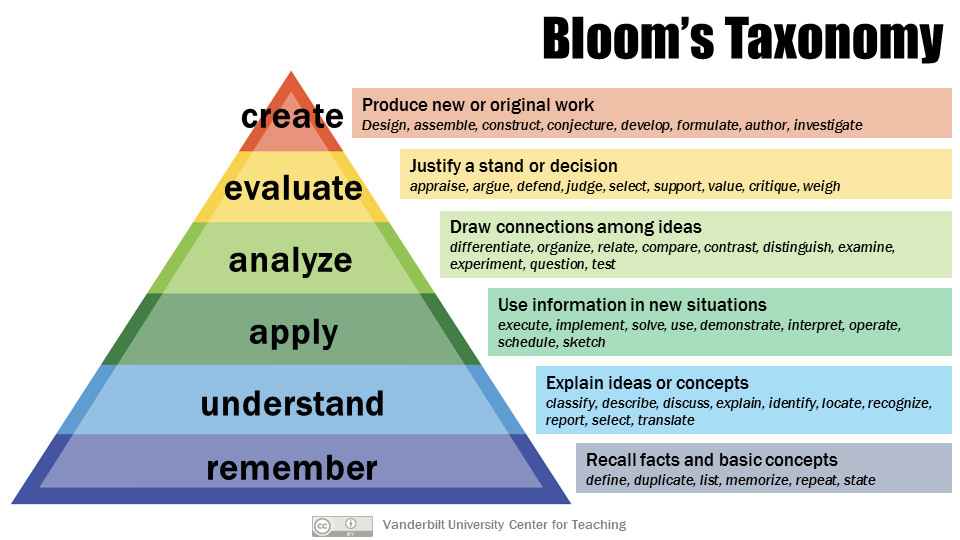
The pyramid begins with a base of remembering basic facts and concepts. Then, once the learner has achieved that level, they can progress upwards to explain or teach those ideas. Next is applying the information in different situations. The next level would be being able to connect those ideas to new things. Second to last is justifying a decision, defending, or supporting something. The final level is producing new work with the concepts the student has learned. The entire pyramid shows how a student can expand their learning and achieve mastery on a topic.
GPA as a fixed measure of intelligence
In past years, the intelligence of a student has typically been measured by their GPA. It helps decide where a student can get into college, how well a student is expected to perform in a specific class, and can end up limiting a student’s learning experience because of what they are told they are capable of.
The term for factors like GPA and SAT or ACT scores as a measurement for intelligence is called intellective factors. These ways of ranking a student are important and often close to accurate, but there are a lot more factors called non-intellective factors that play a key role in a student’s intelligence.
Personality and motivation
Personality and motivation, which are both non-intellective factors, are very important predictors of a student’s intelligence, and once a student understands how to improve these aspects of themselves, they can improve their performance in school (Richardson).
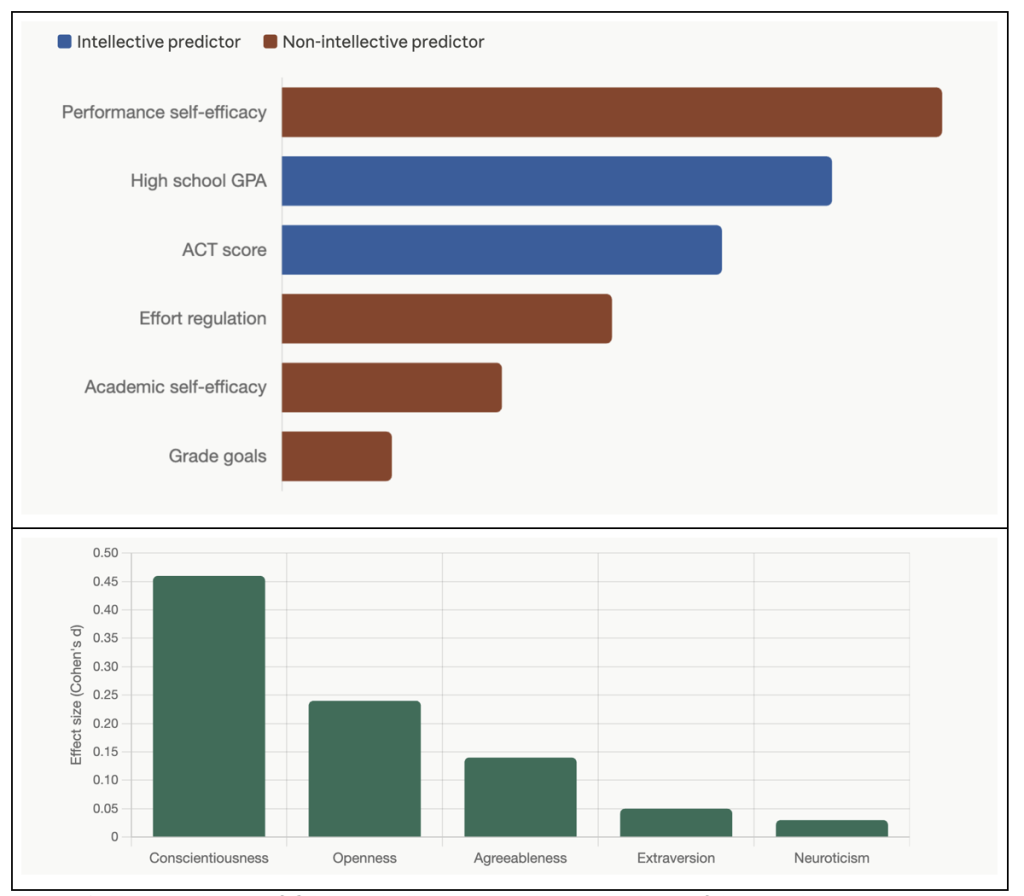
The first graph shows that performance self-efficacy is the leading factor and can help improve a student the most. Intellective predictors, such as high school GPA and ACT score, are next on the list. The rest of the non-intellective predictors, like effort regulation, academic self-efficacy, and grade goals, are still very important but play a smaller role.
Similarly, other personality traits can lead to an increased GPA. The most critical is conscientiousness, then openness, agreeableness, extraversion, and finally neuroticism. None of these will decrease the GPA; some just assist it more than others.
These graphs help to put it into perspective that having confidence, staying organized, and setting goals can help a student achieve their goals and produce a higher GPA.
Personality traits and their effect
If a student wants to succeed in school, one of the simplest ways is to have the personality traits to do it. These don’t just have to be something they’re born with, but a character trait they can adapt to and improve upon. The biggest factor is being organized, disciplined, and achievement-motivated. This can look like students staying on top of homework, keeping their school bag clean, keeping track of when they have assignments due or when an assessment is, dedicating time to study or do work, and setting goals.
Another super important trait is openness. This is the curiosity and willingness to try new ideas and learn. If a student constantly lives in a state of never trying new things and sticking to what they know, they will never learn and never get better at anything. This can look like stepping out of their comfort zone, trying something they’ve never done before, failing, asking for help, and working with others.
There are also bad traits to have, like procrastination and emotional instability. These can be bad habits or things to work on; however, if a student wants to improve their learning, they should stick to the most important traits.
Motivational Factors and their effect
One of the best ways to change a student’s actions and take accountability for how they will perform in school is to work on motivation.
The best way to do this is to have performance self-efficacy, which is having confidence in one’s ability to complete a task or generally do well in school. It’s also good to set grade goals for oneself. Goals are really important to keep on track and motivated towards success.
Intrinsic motivation and need for cognition can motivate a student for the right reasons — not just for the outcome but for the love of learning. If a student loves what they’re learning, it will automatically become so much easier. This is why some students might perform well in one class and not as well in another; It’s not necessarily because one’s harder than the other, but because they love and care about one class more than the other, and therefore it makes it easier. If one loves to learn, they will learn well.
Finally, having a good locus of control and optimism can shape a student’s mindset to be able to do hard things and have positive outcomes.
Self-regulated learning and study strategies
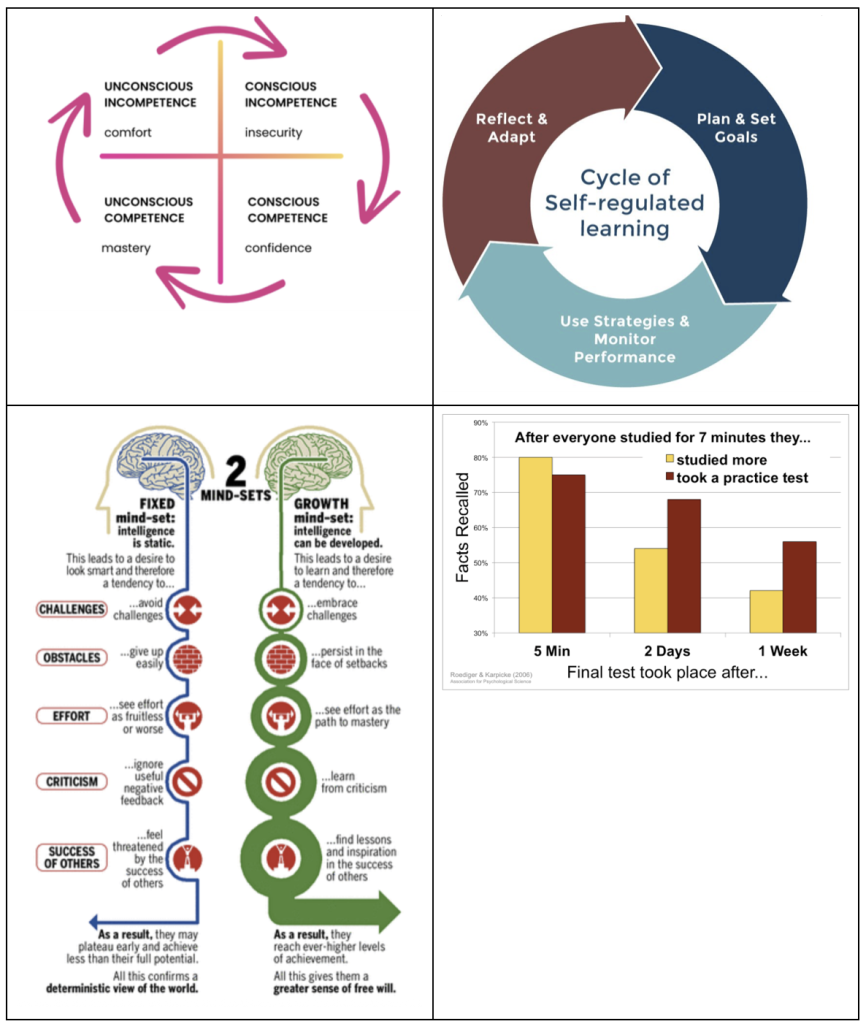
In the top left is a diagram created by Noel Burch of Gordon Training International. This cycle describes the very basics of learning and helps remind students where they might be in the process of learning anything.
A learner begins in unconscious incompetence, meaning they are unaware of what they don’t know and are comfortable. The second stage is conscious incompetence. This is marked by insecurity because they see what they need to learn. The third level is conscious competence, which is reached after practice. At this point, the learner can perform the skill correctly, but it still takes effort and contemplation. The final stage is unconscious competence, where the skill becomes automatic to the learner.
Next, in the cycle diagram in the top right by Zimmerman (1989), is the process for self-regulated learning, which is important to every individual student. It shows how accomplishing a goal begins with planning and setting goals to gather ideas and create a study strategy. The learner then uses those strategies and carries out their goals while monitoring their performance. In the final stage, the learner self-reflects and attributes the success or failure of the work to a controllable cause like effort or strategy choice rather than luck.
Next, in the bottom left corner is the difference between a growth versus fixed mindset. It was taken from Carol Dweck’s book: Mindset: The New Psychology of Success. It shows how people with growth mindsets learn from their mistakes, take on challenges, and work with inspiration from others to reach higher levels of achievement than their peers who don’t. People with fixed mindsets might instead give up easily, avoid hard things, and feel threatened by the success of their peers, and as a result, they will never achieve their full potential.
Lastly, in the bottom right corner is a graph describing the best ways to study. The figure from the Association for Psychological Science by Roediger and Karpicke (2006) shows the percent of facts recalled by students who studied more versus students who took a practice test. It shows that students who took practice tests were able to remember more facts long-term because they learned better. Those who studied more did better after five minutes, but then their percent of facts recalled dramatically declined because they weren’t able to remember the information long-term.
All of these figures tell a story about how students can most effectively learn things and make progress with studying (Xu).
Research on memory has shown that memory can fade fast unless it’s actively and consistently practiced. That’s why it’s better to space out studying than cram the night before a test. Reviewing material once, then again a couple of days later, and then again a week later is forcing a student’s brain to retrieve the information from scratch each time, which is exactly the purpose of active recall. Every time one struggles to remember something and then figure it out, they are making that memory stronger and stronger, which makes it last even longer.
This is also why elaboration is so helpful. It allows the brain to make pathways to that memory and find even more reasons to remember it. The best learner isn’t necessarily the one who studies for the most hours, but it’s the one who studies the best, and planning out your studying as described is the best way to retain information, understand its importance, and end up performing your best on an exam.
A huge part of learning is failing. Without failing and without making mistakes, one will not learn. The brain remembers things better when one fails multiple times. It takes harder work to teach oneself why one got it wrong and what the real answer is, and therefore remembering it is easier because it took more energy to process it.
Another strong piece of learning is concentration and focus in class. It seems obvious, but the less a student pays attention in class, the less they’re going to know. If one actively engages, asks questions, debates responses, and works with peers, they are building the muscles in the brain to actively learn the information and remember it.
The Forgetting Curve
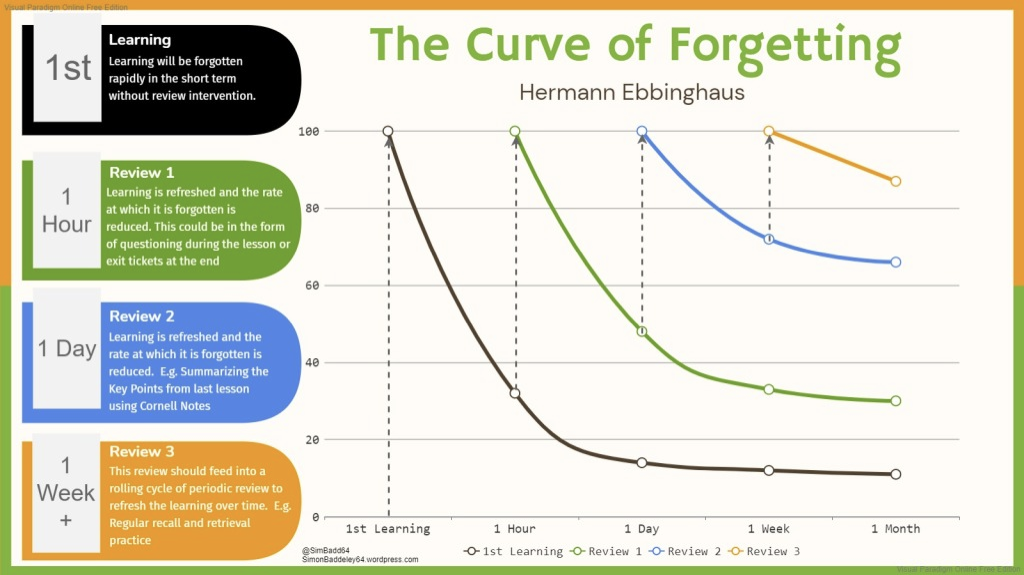
The forgetting curve discovered by Ebbinghaus and proven time and time again by other researchers has shown that right when a student learns something, they remember close to 100% of it. Within the first 20 minutes, they have already forgotten a good portion of the information. By the next day, they might only remember 30-40% of the information, and then after a week without review, the number drops even further, continuously declining by just a little more slowly every week (Murre, Dros).
This proves that most of the forgetting actually happens very soon after one learns the information, so the best time to review anything is quickly after learning it, and again that night, and then the student can slowly start reviewing it less because the forgetting curve slows down.
There was an interesting finding that memory actually increases when one sleeps. This shows the importance of sleep in memory consolidation, and without sleep, it’s even harder to learn and remember things.
The Physical Learning Environment
Most classrooms in the past have consisted of rows of desks with uncomfortable seating. Students sit in classrooms for hours listening to their professors lecture to them. There was little communication between the student and the teacher and from student to student. This raises many issues in a student’s learning (Kariippanon).
First of all, students learn better when applying their knowledge to something, working out problems with peers, and making mistakes and learning from those mistakes. Without communication and problem-solving, students are just passively hearing information.
Because students are stuck in their seats for so many hours of the day, being forced to sit still and stay quiet, they can become restless and even more distracted by small things, having a hard time focusing on the learning at hand.
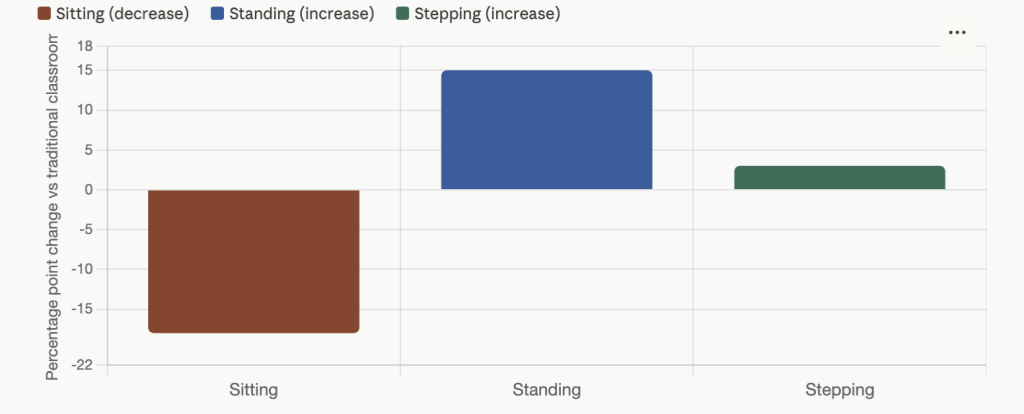
Sitting down for long periods of time can actually decrease a student’s GPA. On the other hand, standing for longer periods can increase a student’s learning. There are also many more health benefits related to standing over sitting.
Stepping can also mildly increase a student’s GPA, but not as much as standing. This graph helps to prove that flexible learning spaces are a really positive environment for students in which to learn.
However, there is another side of the argument. Flexible learning spaces can be a distraction. Being able to choose one’s seating, some students might choose to sit next to their friends, and instead of paying attention or getting work done, they might be more inclined to talk about outside topics and be off task.
Perhaps there is also a limit to how “fun” the chairs should be. It’s good to have movement in the classroom to help with learning; however, too much can turn into playing around or goofing off and can become another distraction that will take away from learning.
Perhaps there needs to be a balance in what is considered a flexible learning space, such as standing tables, which tend to result in better learning and are generally better for the body. And in terms of seating arrangements, it can be helpful for students to sit near someone they feel comfortable having discussions with and truly deciphering information, but the second it turns into distracting behavior, the seating should change.
Socioeconomic factors
Another part of the physical learning environment that has more of an impact than people have realized is socioeconomic factors. Socioeconomic factors such as household income, education, and neighborhood can be clearly seen in MRI scans of children’s brains (Hamilton).
This is because in these types of circumstances there can be less social support, more stress, and less sleep. This leads to stress hormone signaling and arousal, which can affect a child’s motor and sensory parts of the brain.
Sleep is also a very important component of memory consolidation. When you sleep, all of your memories get organized and locked into your brain. With less sleep, students remember less and aren’t considered as smart as other students. This is then seen in their MRI scans and has now been linked to how well these students perform in school.
They were not necessarily born with a lower IQ, yet they have suffered disadvantages that have affected the way their brain will work forever.
Future (AI as a tool and with risks)
Benefits
Moving forward in education, AI is taking over some of the traditionally human-performed roles. It is also becoming a learning assistant to students.
In one study, AI feedback was rated more helpful than human tutor feedback (70% vs 45%). This is a great tool for students and doesn’t necessarily out-compete teachers or make them useless, but instead provides extra assistance and more personalized learning for students (Burnett).
This also ties back to the issue with socioeconomic factors. Underprivileged students don’t have access to tutors or private education, and with the implementation of free AI, students can get the extra help that they deserve.
Another source found that AI automated grading was more reliable than human grading. AI scoring reached 97.21% reliability, and human graders had 95.23%. This statistically proves the future of where education should be heading and why (Blanchard).
Many people spend a lot of time worrying about others’ moods and maintaining relationships, and often this gets in the way of having good conversations, giving meaningful feedback, and getting a task done more efficiently. But one doesn’t need to worry about maintaining a relationship with AI; one can give it honest feedback, share deep and personal information that one might not share with a person, and get a true, honest answer. Nobody’s feelings are being hurt, and more time can be spent on the job at hand.
Philosophers Simone Weil and Iris Murdoch say that the core of being a good, ethical person is giving someone your full, true attention, and humans are generally horrible at this, but AI is good at it. Now that we have the resources to really excel at a task, why not use it?
Risks
There are tons of benefits to the future of education; however, there are equally as many risks.
The most obvious risk is how students might abuse AI and have the “illusion of understanding”. Many students use AI to complete things for them and rarely ask follow-up questions, so instead of learning in school, they are having AI do the learning for them, and they are passively turning in information they have no understanding of. When AI makes help too easy, students may stop choosing engagement and effort, which are crucial elements to learning as described in Bloom’s Taxonomy, having a growth mindset, and self-regulated learning.
There is a balance that needs to be created. The future is moving in the direction of AI, and students should be able to use it because they will be able to for the rest of their lives, but to what extent is it fair, helpful, or creating issues that will impact society later?
The truth is, learning is changing. Some people believe we don’t need to know some of the basics anymore because AI can do it for us. And it’s important to move with the times and adapt to new things.
But perhaps we need to figure out what makes humans different from AI. Perhaps we no longer need to collect facts and write textbooks for people to read, but instead we need to discover the answers to questions that only humans can discover through living.
With the addition of AI into our lives, we can often feel scared and intimidated; however, it is a really good thing in some ways. We are being forced to become newly conscious of what it means to be human, live our lives, and what makes us exactly human.
Conclusion and Discussion
The research in this paper shows a lot about how personality, motivation, study habits, and environment can affect how well students do in school. However, these studies aren’t always perfect. Many of them used small groups of students and only checked results for a short period of time. This makes it hard to know if things like feeling more motivated resulted in better grades in the long run. The research on flexible seating is still pretty new, so one can’t be sure how much it really helps. Even GPA isn’t a perfect measure because all schools grade things differently, and grade inflation is becoming increasingly prominent.
Neuroscience adds important input as well. Studies have recently proven that socioeconomic factors resulting in more stress and lack of sleep can change how a brain develops. This means that some of what people consider motivation issues are actually caused by unfair life circumstances, instead of just being lazy. In the future, it would be helpful to combine brain scans with studies on study habits and mindsets, so we can better understand not just what helps students learn but why some students have a harder time than others learning.
One of the biggest questions for the future is about AI. Recent studies have shown that feedback from AI can be much more helpful than feedback from a human tutor, and AI grading systems can be just as, if not more, accurate than a teacher grading by hand. AI can also be assistance to students who don’t have access to tutors or extra help in school because of their socioeconomic status. But there are still risks. If students let AI think for them instead of using it to support their own effort and learning, they could end up in a similar trap as passive rereading: feeling like they understand something, but they aren’t actually learning it. With the rapid increase of AI and technology, future research needs to figure out the best way for students to use AI to think harder and remember things better instead of as a shortcut.
References
About the author
Sloane McDowell
Sloane is a senior in high school in Orinda, California. She plays lacrosse, is a part of numerous clubs, and loves to volunteer at her local memory care nursing home. Sloane has always had a passion for science, and specifically the brain. She would love to study neuroscience and become a neuroscientist.